This issue of Partout is brought to you in black and white because nothing better sums up our impressions after five days in Turkmenistan than these two deeply symbolic colors.
Let’s start with white.
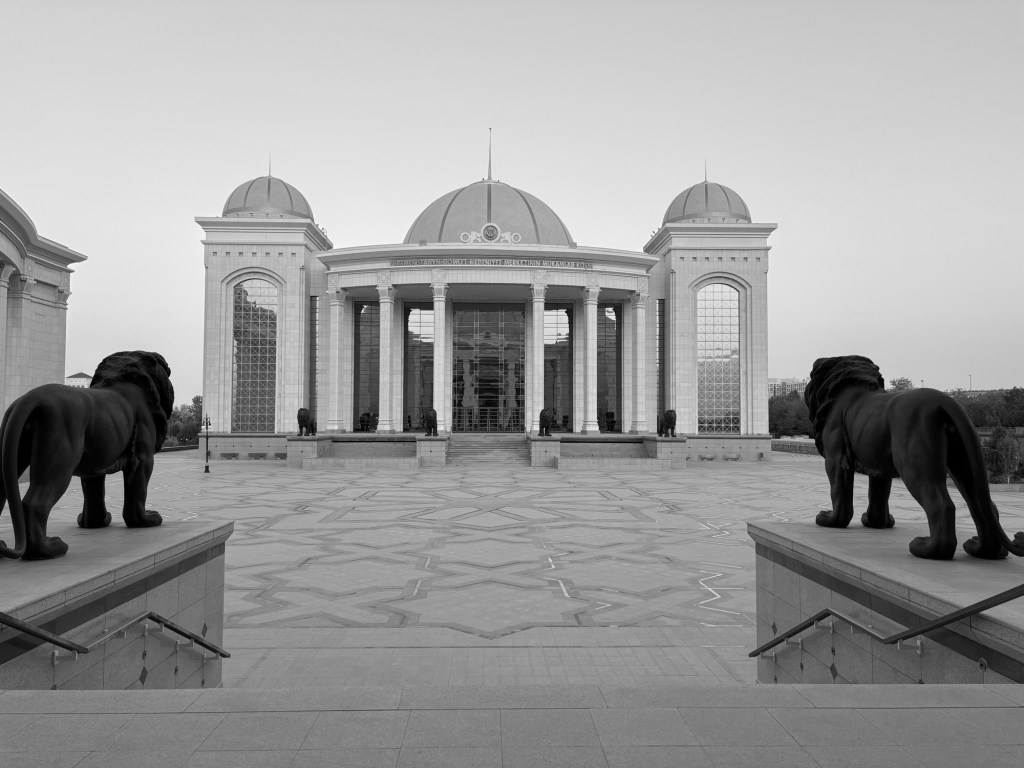
When the USSR collapsed, a hardcore Soviet apparatchik named Saparmurat Niyazov rose to power and, as quick as you can say “absolute power,” assumed the title President for Life. Dispatching all political opposition and any hint of democracy, he set out to transform the capital city of Ashgabat into a visible declaration that Turkmenistan had arrived on the world stage.
To signal purity and modernity, Niyazov chose white as his theme. White marble to be precise. Something like 12 million tons of white marble. Enough marble to fill the city with stupendous white marble monuments and public buildings and to clad more than 500 structures.
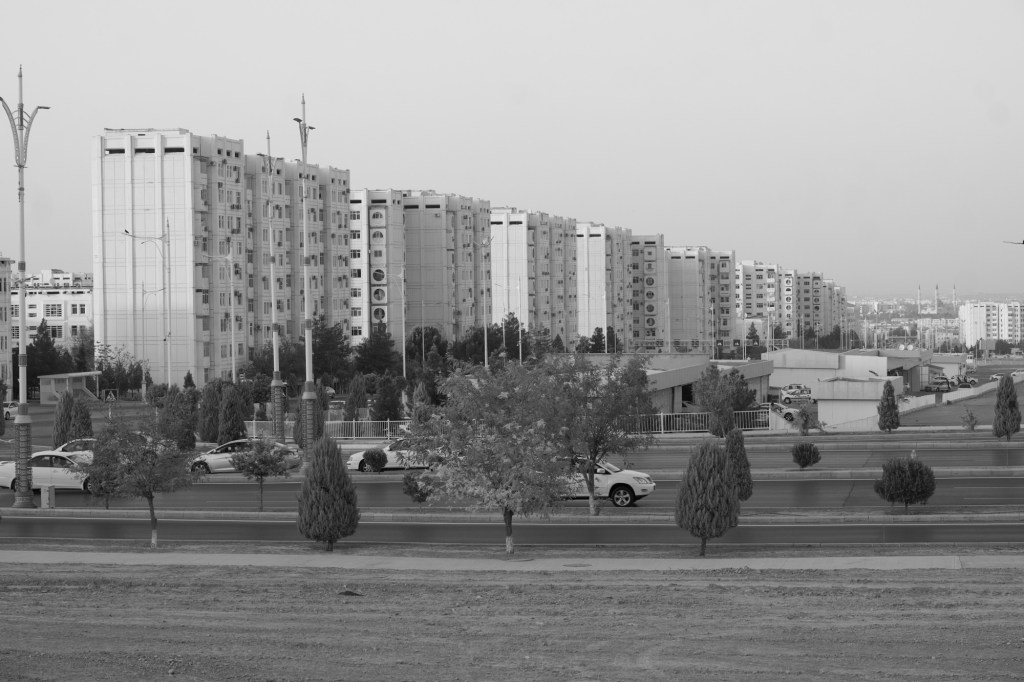
Guinness World Records has recognized Ashgabat for having the highest density of white marble-clad buildings in the world. There is literally no end to white. What isn’t white marble is white paint. Street poles are white, traffic light standards are white, the automobiles are universally white (or very light silver) to preserve visual harmony. Dirty cars are officially banned from the capital because they are not white enough.

The effect is hard to describe. Other-worldly? Surreal? Like waking up on another planet? In our two lifetimes of travel, we’ve never seen anything quite like Ashgabat. (The white theme has also been carried out in smaller Turkmen cities but with white paint instead of marble.)
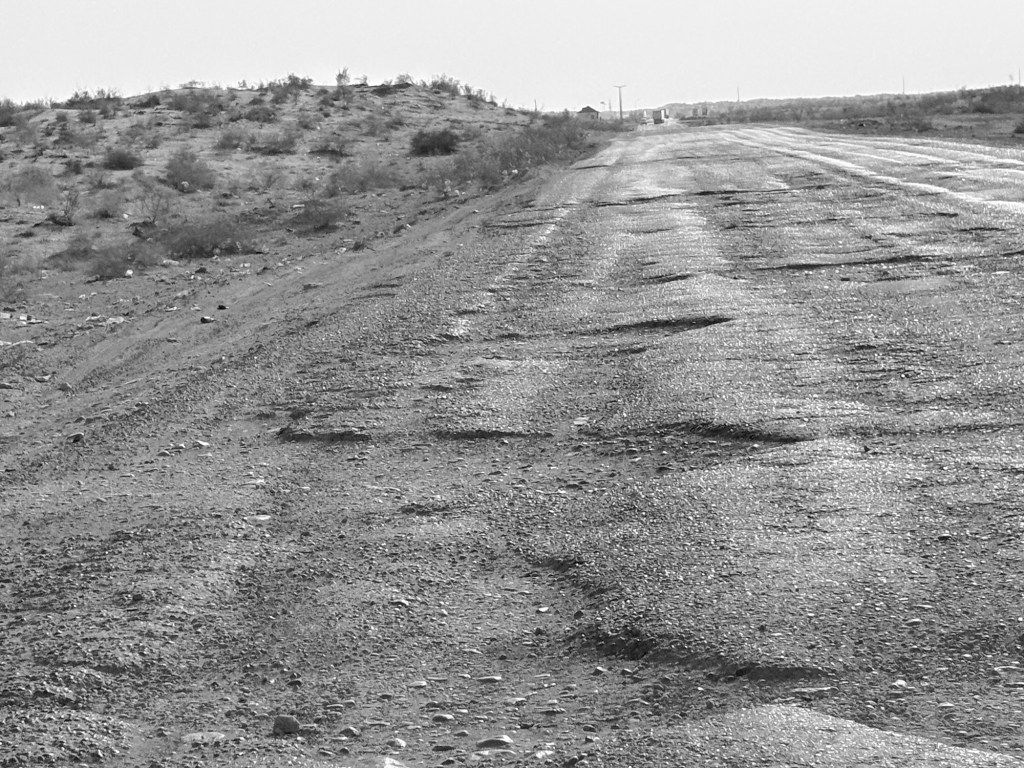
The black is less visible but no less symbolic.
Our first impression that Turkemistan is not synonymous with North Korea held up (though it is reported the capital of Pyongyang is equally surreal but in a more Soviet style). We saw for ourselves that Turkmens and visitors can cross its borders freely, albeit slowly. VPNs may be officially banned, but the population still uses them to access YouTube and Facebook, to view Instagram and to communicate on WhatsApp.
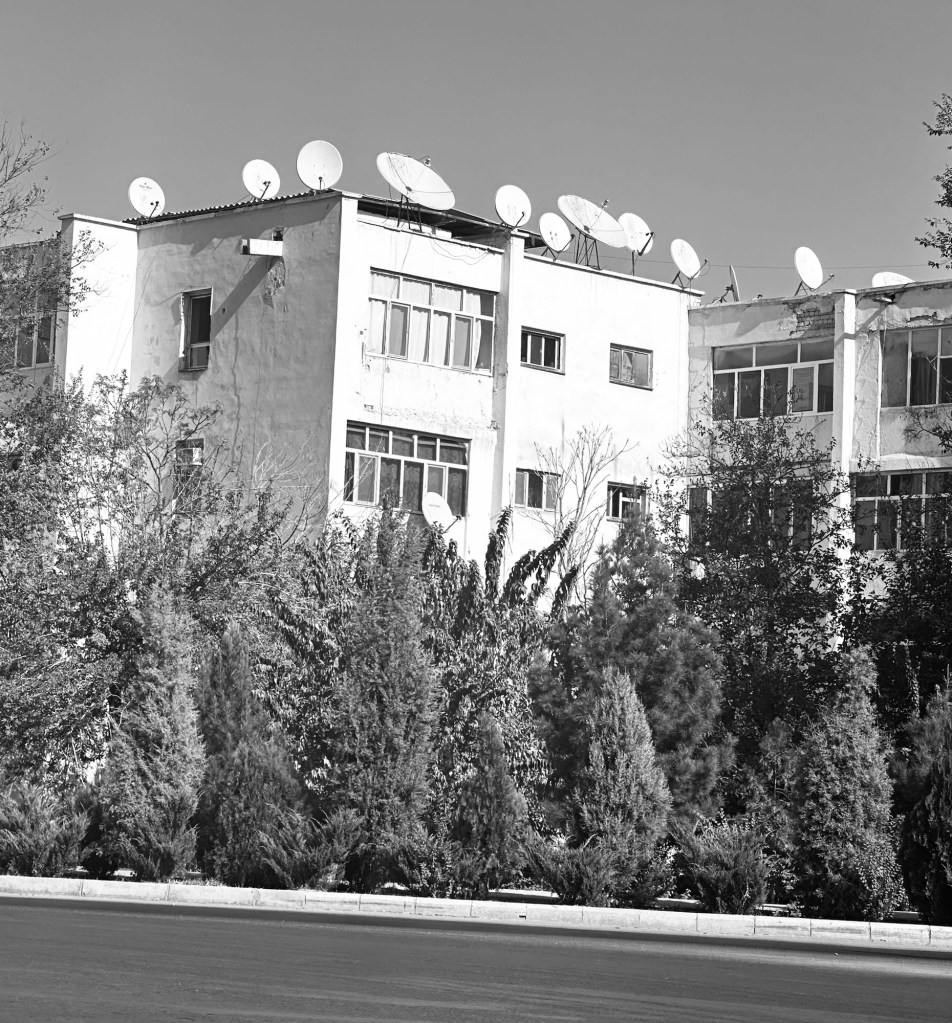
When we quizzed our guide on whether there was an equivalent to the Great China Firewall of China, he seemed genuinely puzzled by the concept.
Turkmens are free to worship — or not worship — as they like; it is not a religious country. Our first impression of personal friendliness held up with each encounter. We were greeted with more smiles, random greetings and physical warmth in five days in Turkmenistan than in the other four Stans put together.
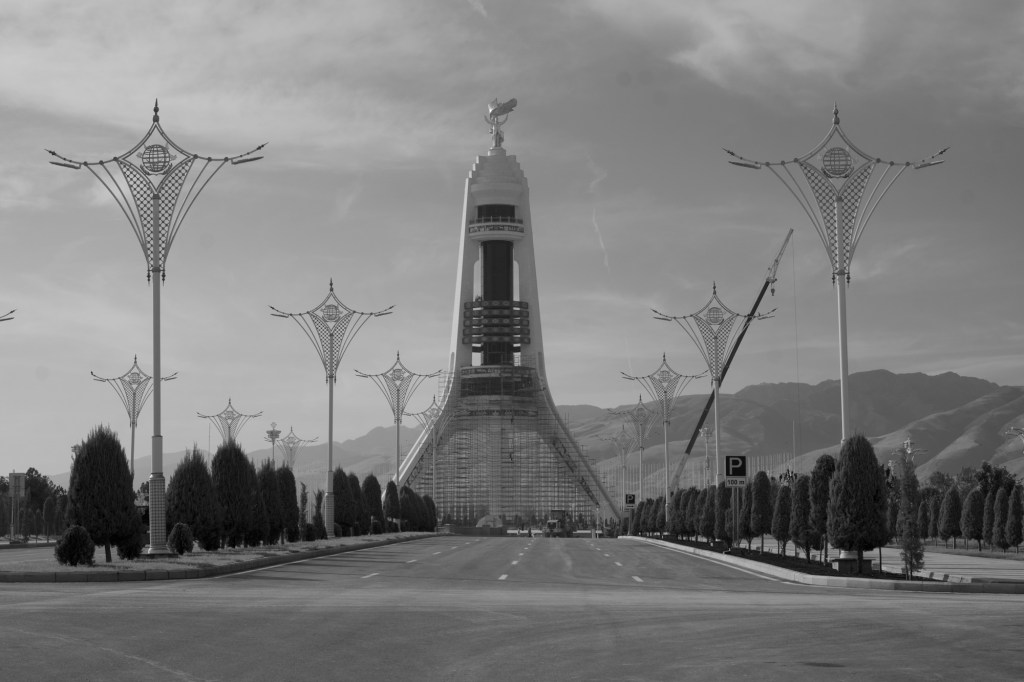
Like all the Stans, Turkmenistan is fiercely proud of its country’s independence. It seems equally proud of its official neutrality since 1995, a position the UN regularly applauds. The finishing touches of a monument to the policy were being applied as we took a pre-opening drive-by to see it.
But life is not remotely free in Turkmenistan. Manicures and pedicures are deemed “unpatriotic” along with any other beauty treatment that is remotely Western including hair coloring, false eyelashes and cosmetic treatments like Botox. Salons that provide simple nail cleaning are allowed but subject to raids to make sure they are not secretly applying nail polish. State employees can be fired if found to be in violation. Lipstick is banned, of course. So is lip synching.

Dissent does not exist (no No More Kings protests here). Speech is circumspect. When we asked our guide particularly delicate questions, he would answer by laughing. (Laughter would likely have been his answer to “Why is lip syncing against the law and naughty lingerie is not?”) When we asked why he was laughing, he would laugh harder. Enough said.
Drones are forbidded and “no-photos” zones are everywhere but hard to predict, and Louis got commands to stop photographing even in places that didn’t strike us as having military or strategic significance, like a gas station.

According to international agencies that monitor them, elections are not free or fair, and only groups loyal to the regime operate at all. Constitutional “reforms” that occur are designed to entrench the absolute powers that be and to suppress civil liberties to in order to keep the powers entrenched.
The list goes on and on. In the end, Turkmenistan’s show of visual purity and modernity was absolutely dazzling.
In the shadows behind the marble monuments, darkness still rules.
Your Questions Answered
(We will take on a question or two at the end of each remaining blog. )
Q: SlowlyPuppy asked: “Will you, by any chance, be publishing an expanded version?”
A: If you mean “a book,” over Doris’s dead body. If you mean more Partouts after the trip ends, probably. Normally, Partout ends with our last flight, but we have too many unshared stories and unpublished photos to stop in four days, when we reach San Diego. Besides, we haven’t given readers Potty Talk yet, and this will be the wildest Potty Talk, ever. Stay tuned.
COMING SOON! Sunrise over Bukhara

 Partout with Louis & Doris
To live in a city where dirty cars are banned……..fascinating.
LikeLike
This is a fantastic article…insightful and full of twisted details and great photos!
I am truly envious you got the chance to experience this surreal place. I do wonder though why you don’t think it’s like North Korea. It sounds exactly like North Korea to me. Maybe a little more relaxed in terms of coming and going ? but when they travel where do they travel to ? and who is allowed to leave ? also wondering if they are religious , where do they pray ? is there not an official religion? I thought they were muslim.
I was fascinated and horrified to here no manis and pedis allowed. it is the same in NK apparently. They have Beauty Police who enforce this law. What a fascinating story that would be for any journalist in either of these countries.
Did you have internet when you were there ? Was your guide like a minder ? were you allowed to go out on your own ?
So many questions. Please write a few more followups on this bizarre country. I really want to go one day.
Corinne
LikeLiked by 1 person
In short about NK differences, there are no public executions, no hereditary punishment (imprisoning an entire family for one member’s misdeeds), no minders on the streets (we could leave the hotel alone) and a few more – like our own guide leaving the country to study in the US. To be continued! For now, off to Tashkent.
LikeLike