It’s that time again, faithful followers. Time to talk toilets.
If you’ve come along on our travels before, you know Partout wraps up every major trip with a roundup of public potties we have seen and flushed. Potty Talk tends to be the most-read blog Partout publishes (no comment on that), so we never head to the head without a camera. Prosaic as potty rooms seem, you never know what they might hold.
You might think that, after taking potty pix in something like 50 countries, we would be running out of material for Potty Talk. You would be wrong.
Granted, some photo opps are variations on a familiar theme. The toilet paper theme, for example. Where to dispose of toilet paper is perhaps the most common subject of potty signage after gender or non-gender labeling.
In general, TP disposal practices divide into two camps: flushers and tossers, mostly dependent on the vigor of the local sewer system but sometimes on custom as well. (There is also a TP-free camp we will come to shortly.)
The winking little graphic below pointed to a wastebasket. This made it pretty clear this WC was in the toss-the-TP camp.

But appearances can deceive, and reading the fine print is imperative. The graphic in the following sign seemed to say, “DON’T flush the paper,” but reading the fine print revealed it was actually instructing “DO flush the paper.”

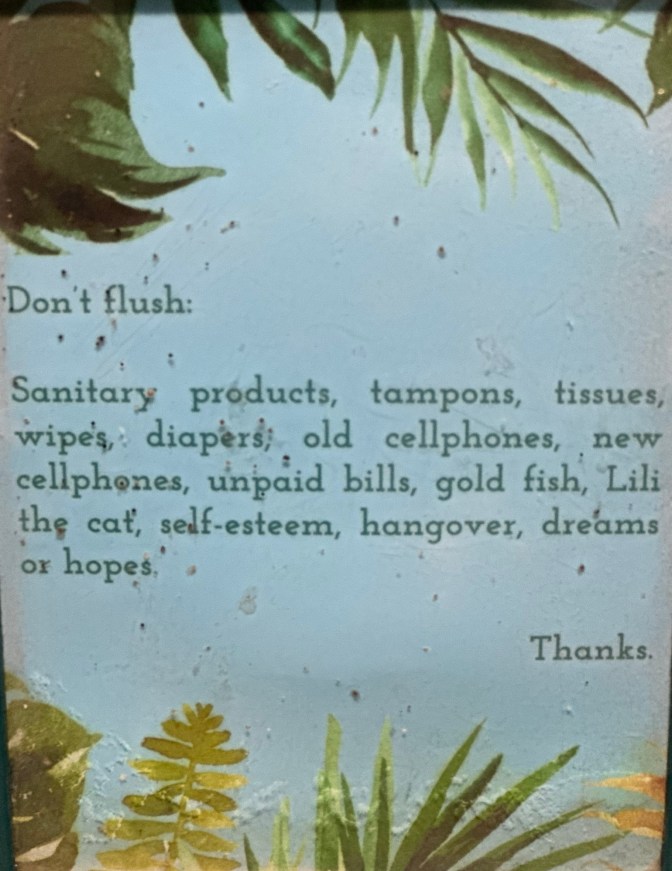
We always enjoy a potty that makes the don’t-flush point with humor.
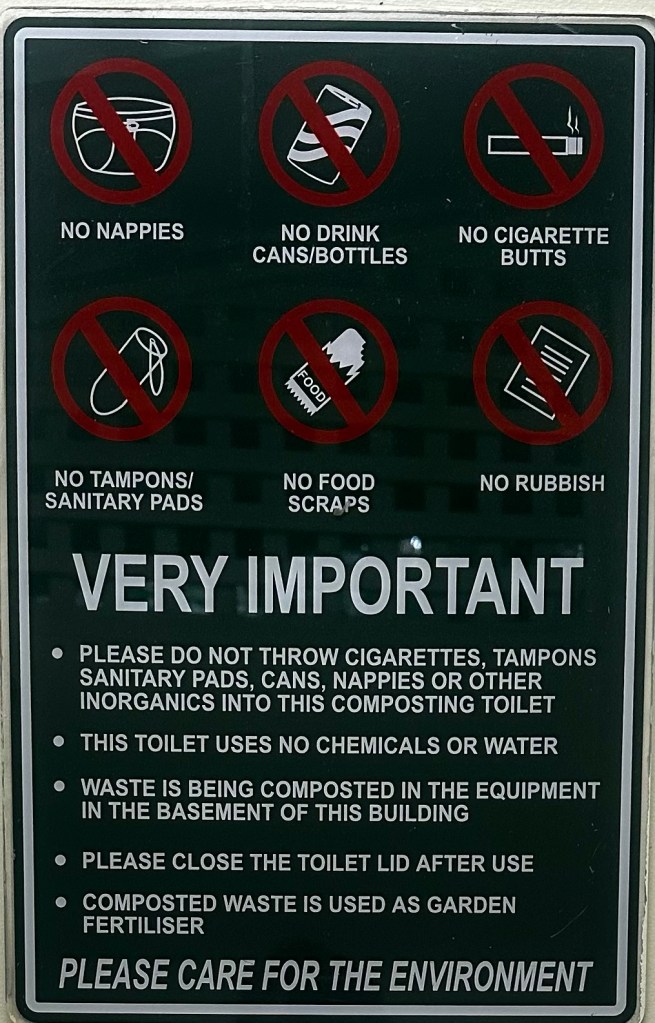
Just as fun are the instructions that aren’t meant to be funny but can’t help it. Honestly, who throws bottles and cans into the can?
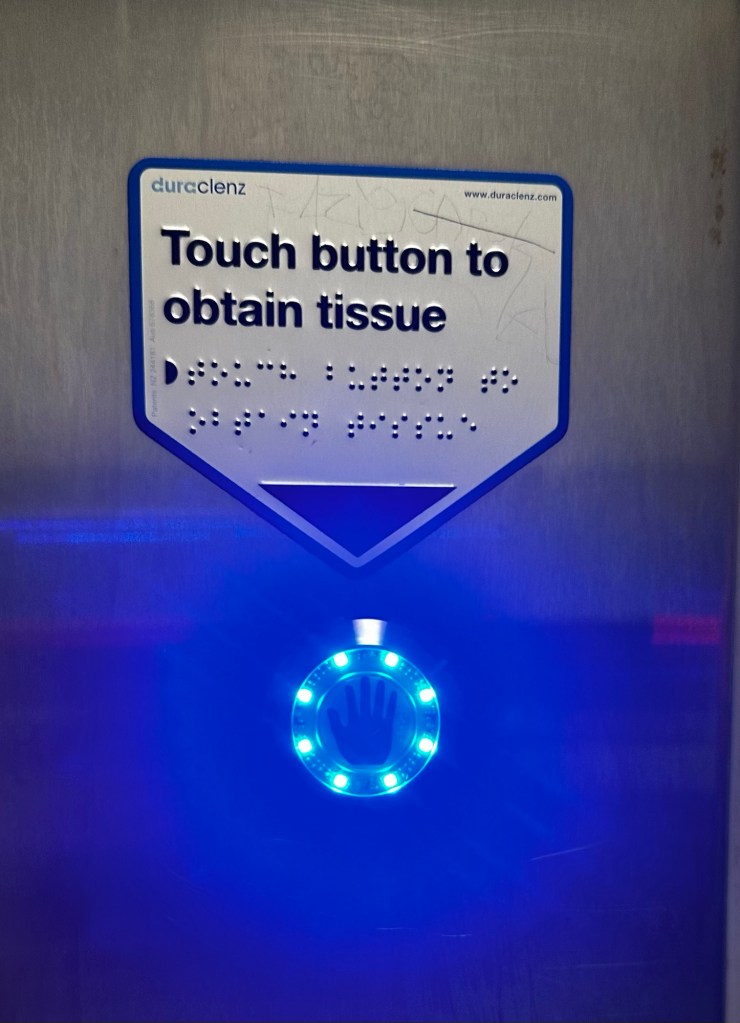
But Potty Talk goes far beyond variations on old themes. Doris and Louis are, after all, retired newsies and thus forever on the lookout for the new, or at least the new to them, which brings us to the interactive loo we encountered in Perth.
The glowing push-button toilet paper dispenser was not entirely novel; it has a cousin in the motion-activated paper towel dispenser that’s been hanging around in bathrooms for years.
But things got really interesting when it came to flushing.

This felt like Mom yelling through the bathroom door, “If you don’t wash your hands, you’re not getting out of this bathroom!” (Alas, there wasn’t enough interaction for us to understand the message of the object in the big C.)
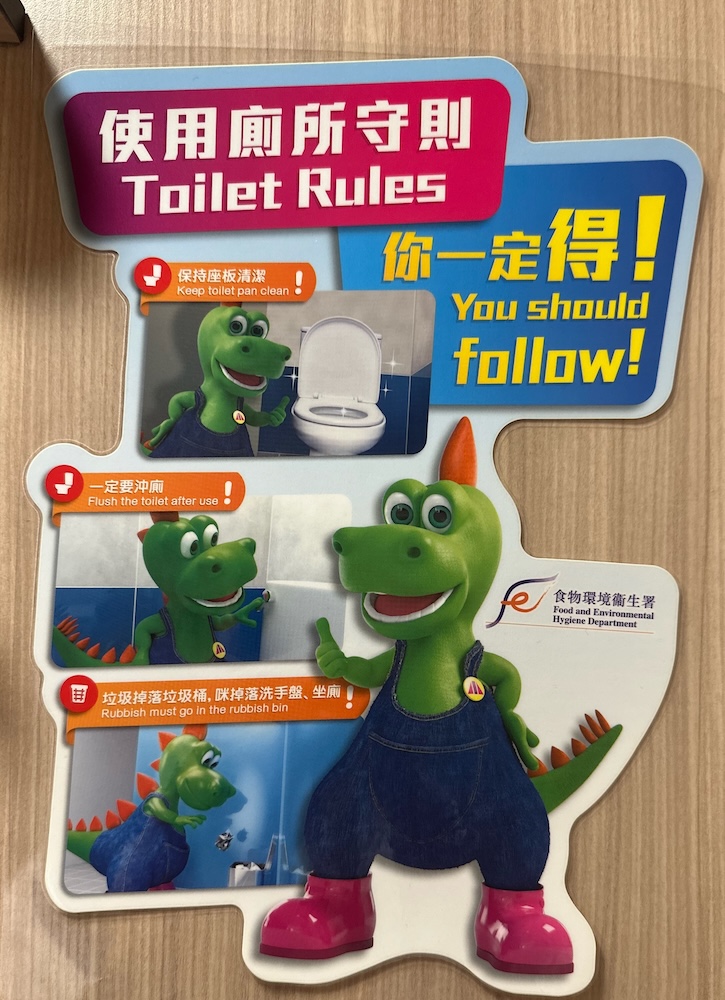
And speaking of things Mom might tell us to do in the bathroom, what makes you feel right at home faster than a nudge to clean the toilet? Based on a sample size of two, we are prepared to break the news that some public potties in Asia now come with housekeeping requests.
This airport WC went with a nicely illustrated less-is-more approach to recruitment.
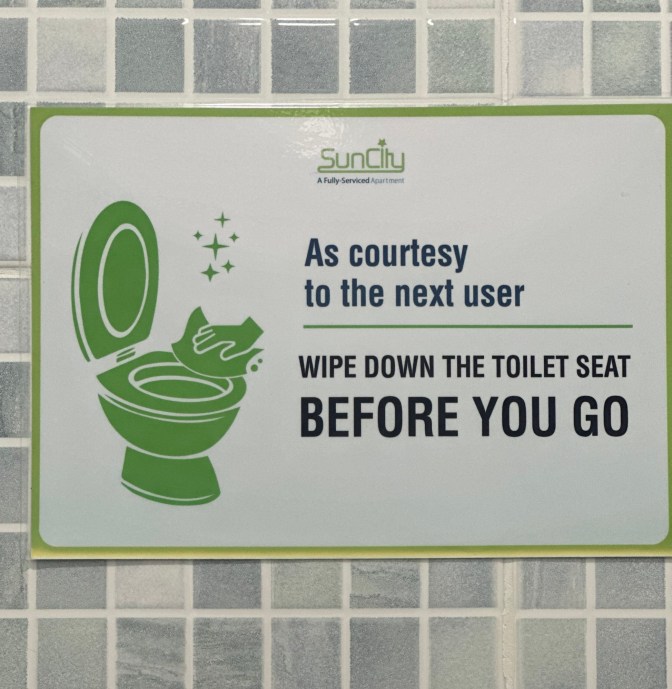
But a restaurant in Hong Kong clearly found more instruction to be necessary.

A bathroom on Indonesia threw cleaning in with other, uh, specific instructions and, helpfully, made them all bilingual and added a polite thanks. Nice touch.

This probably isn’t news to frequent Asia visitors, but we hadn’t spent enough time there lately to notice that bum guns are universal. (If unfamiliar with the bum gun, you’ll find a deep dive into the topic in our 2020 Potty Talk). We are accustomed to musical bidets in Japan, where toilets are an art form, and to hand sprayers in Muslim countries, where cleanliness is a religious obligation. We did not realize the humble gun was also a universal Asian practice.
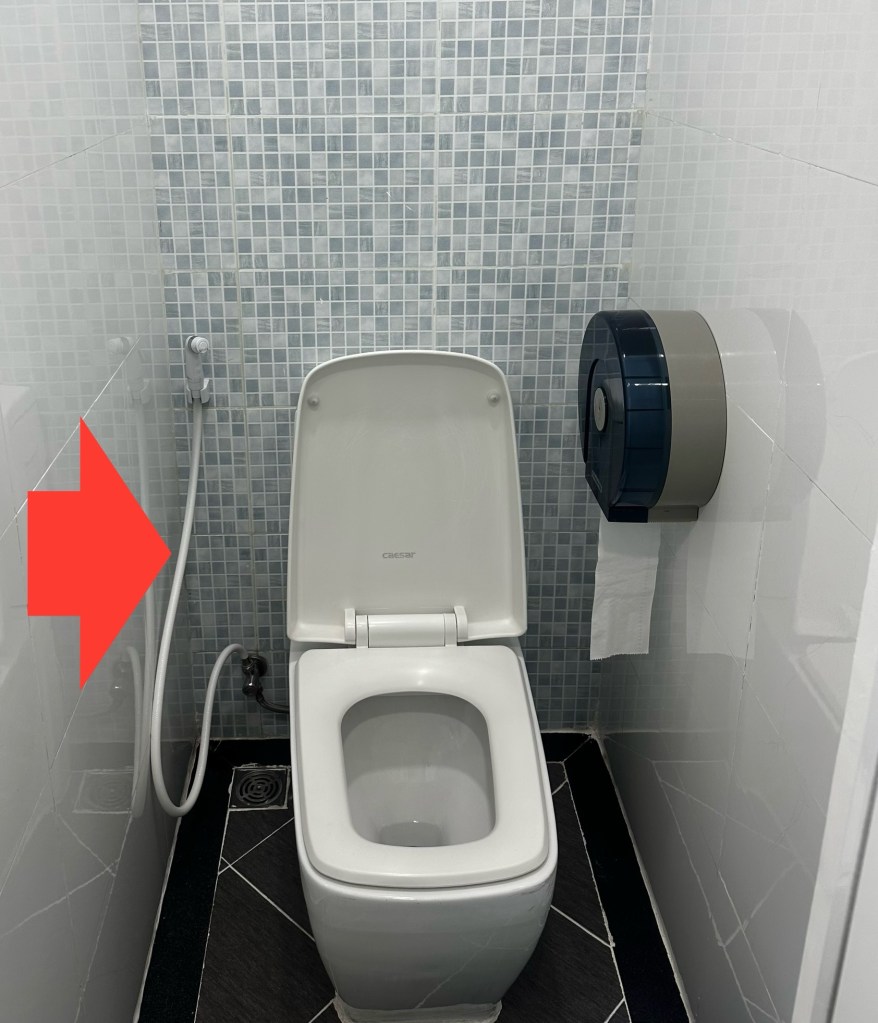
If potty talk is any indication, it turns out that where there’s a bum gun, there’s a chance of missing the target. What else would explain this sign in a restaurant WC near Angkor Wat?

(Aside to readers: If you know what “overwriting” a toilet involves other than writing too much about potty talk, please use the comment function to illuminate us all.)
The bum gun, btw, brings us to the third camp of the toilet paper world: no toilet paper needed. One knows one is in this toilet camp when there is a sprayer in the john but no TP or TP holder to suggest that TP is ever an option. Since there seems to be no such thing as a bum dryer, this camp is a little mystifying, at least to the female half of us, but what’s a trip to the bathroom without a little mystery, right?
Which brings us to this sign in a restaurant restroom near Angkor Wat.

We encountered countless potty prohibitions and instructions over two months of public pottying. We were warned not to wash our feet in the sink, shower in the toilet or pee on the floor and admonished to wash our hands and clean the toilet. We encountered bathrooms blooming with floral arrangements and artistic loos the likes of which we never see in the States.

We saw professionally painted signs and handwritten ones and WCs in every color and decor imaginable.
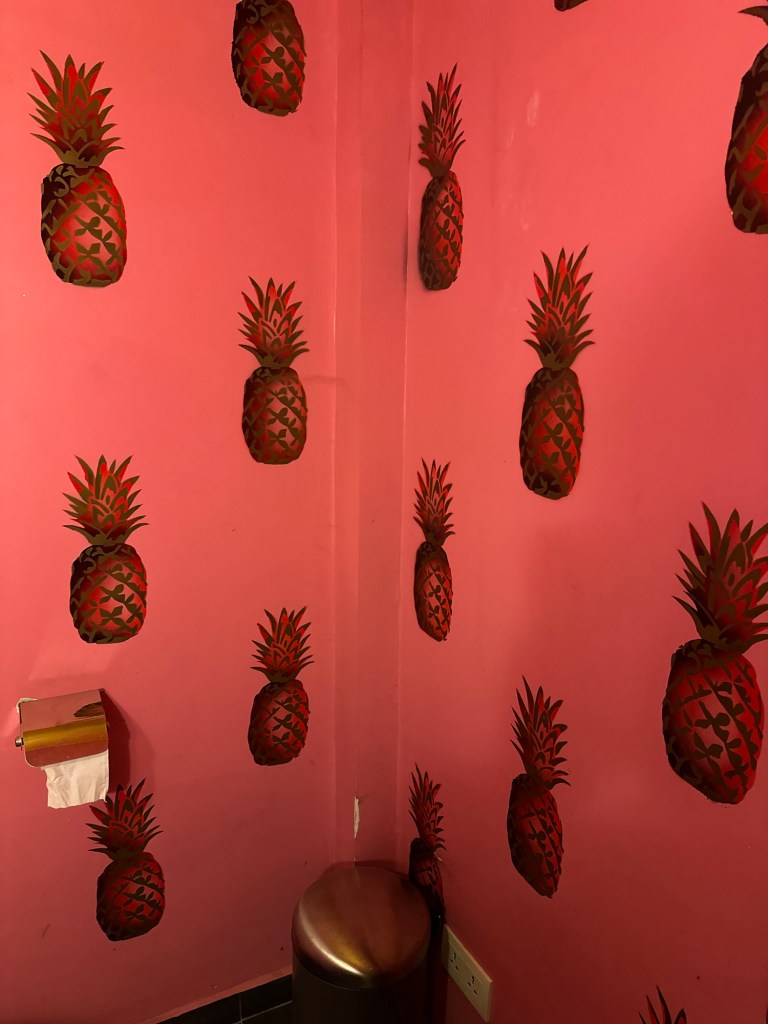
But a toilet detour????
Another travel mystery yet to solve, another reason to keep traveling.

Who Knew?!?
Australia is home to the world’s largest wild camel population, an estimated 300,000 to 1 million feral dromedaries in all. These are descendants of about 10,000 camels shipped down under in the late 19th and early 20th centuries because they were considered well-adapted for exploring Oz’s arid interior. After the automobile was invented, the camels were cut loose in the Outback, where they did what well-adapted creatures without natural predators will do. Now the beasts are considered pests that harm the environment and agriculture and damage infrastructure and Aboriginal sites, disrupting traditional practices. In the port at Fremantle, we spotted livestock ships waiting to board these “ships of the desert” and take them back to the Middle East (a slow-moving boomerang effect?), where they are valued because they are disease-free.


 Partout with Louis & Doris
This blog is an Incredible paring of the arts of writing and photography. Thanks for sharing.
LikeLike
Hahaha, very nice!
LikeLike
I enjoyed the potty talk!
LikeLike
Loved this! So entertaining and enlightening!
LikeLike
omg this was extremely entertaining!!!
LikeLike