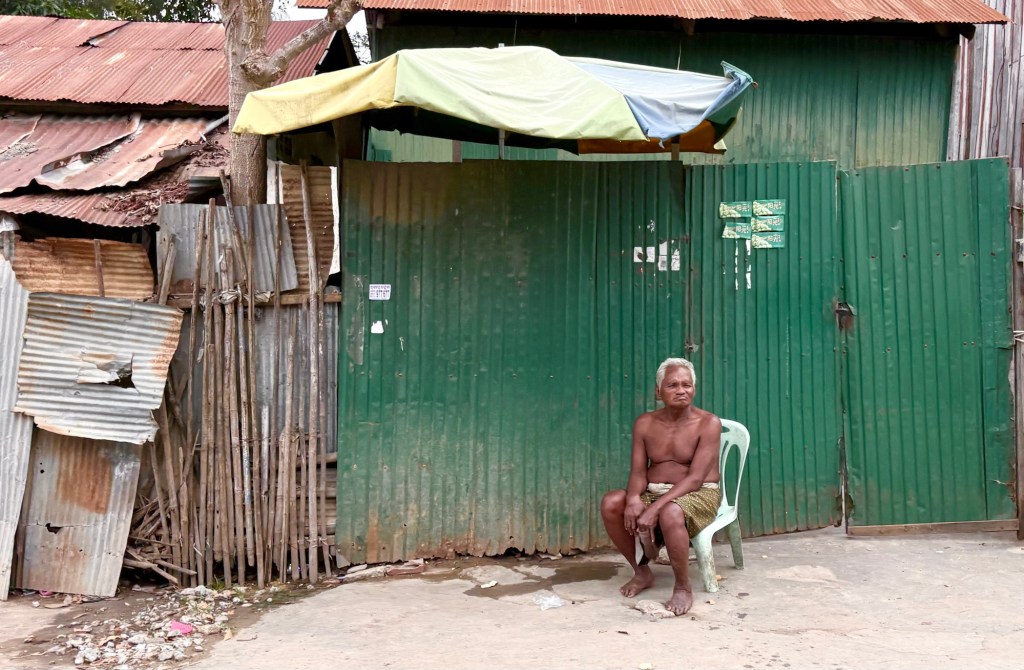
Pity the poor tour guide or taxi driver saddled with two unreformed journalists. The questions never end, and the maxim that there are no embarrassing questions always applies.
One of the subjects we unabashedly asked about in Cambodia was how people make ends meet in a country with a struggling economy and limited employment opportunities. We asked everyone we could corner. Tour guides, factory workers, taxi drivers, hotel clerks. We also wanted to know how poverty challenges their lives beyond the obvious of housing, feeding and clothing themselves.
One challenge we heard about consistently was the dowry barrier to marriage. Men in Cambodia must pay substantial dowries to the families of prospective brides, and brides don’t come cheap. Our guide to Angkor Wat, single at age 36, said he must come up with a dowry of $5,000-$6,000 USD if he wants to marry. In Cambodia’s lingering post-covid tourist slump, he guides tourists maybe five days a month for a gross monthly income of $150-$200, not enough to live on and save a dowry, too. Sadly, he said there is no wife in his future.

The most secure workers we talked to were the ones with regular jobs. Our taxi driver to the Phnom Penh airport counts himself lucky to have been with his employer 10 years, long enough that he didn’t lose his job when the driving service had to sell off cars because of the covid tourism slump that hasn’t ended. Also 36, he is married and the father of a six-year-old son. He hopes to be able to afford a second child in another two years.
We didn’t ask how much the taxi driver earns, but we did ask a weaver at the silk farm we visited on the outskirts of Siem Reap. She said she earns $200/month, the minimum wage for a garment worker in Cambodia. Her work week is six days long, eight hours a day.
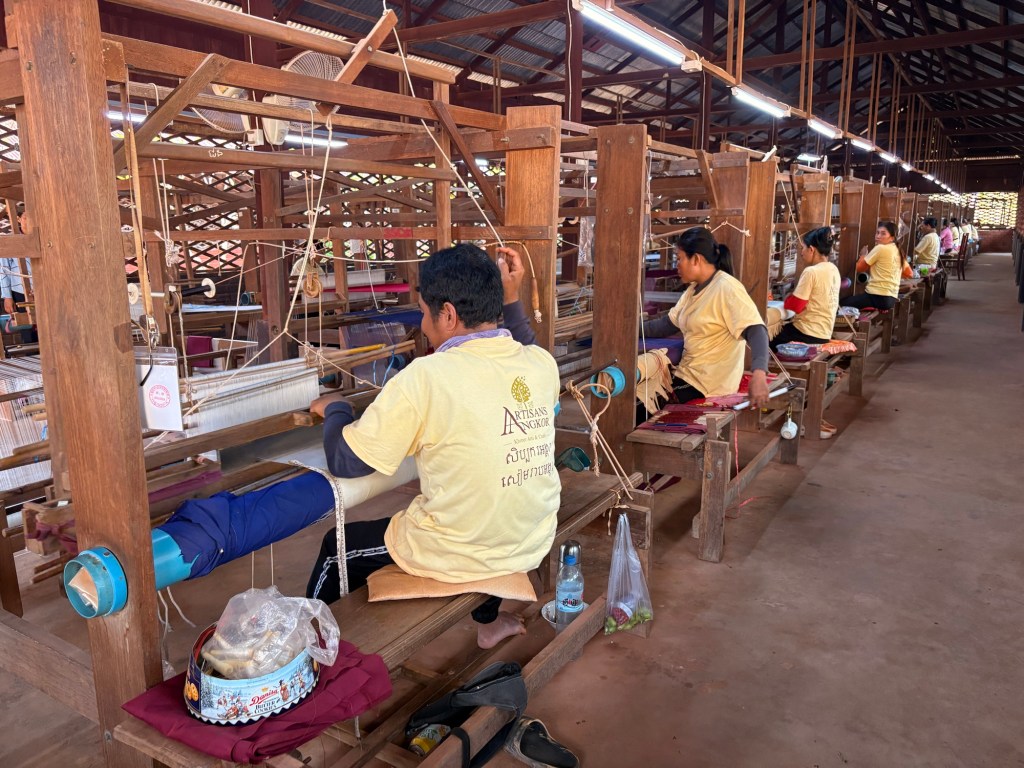
Self-employment is more common than salaried jobs, and much of it is manual work performed without power or mechanical apparatus.
For example, most Cambodians don’t have refrigerators and have to buy their meat and produce fresh every day. This produces street markets operating seven days a week in every neighborhood Women in particular make ends meet by selling foodstuffs they grow or raise at home.
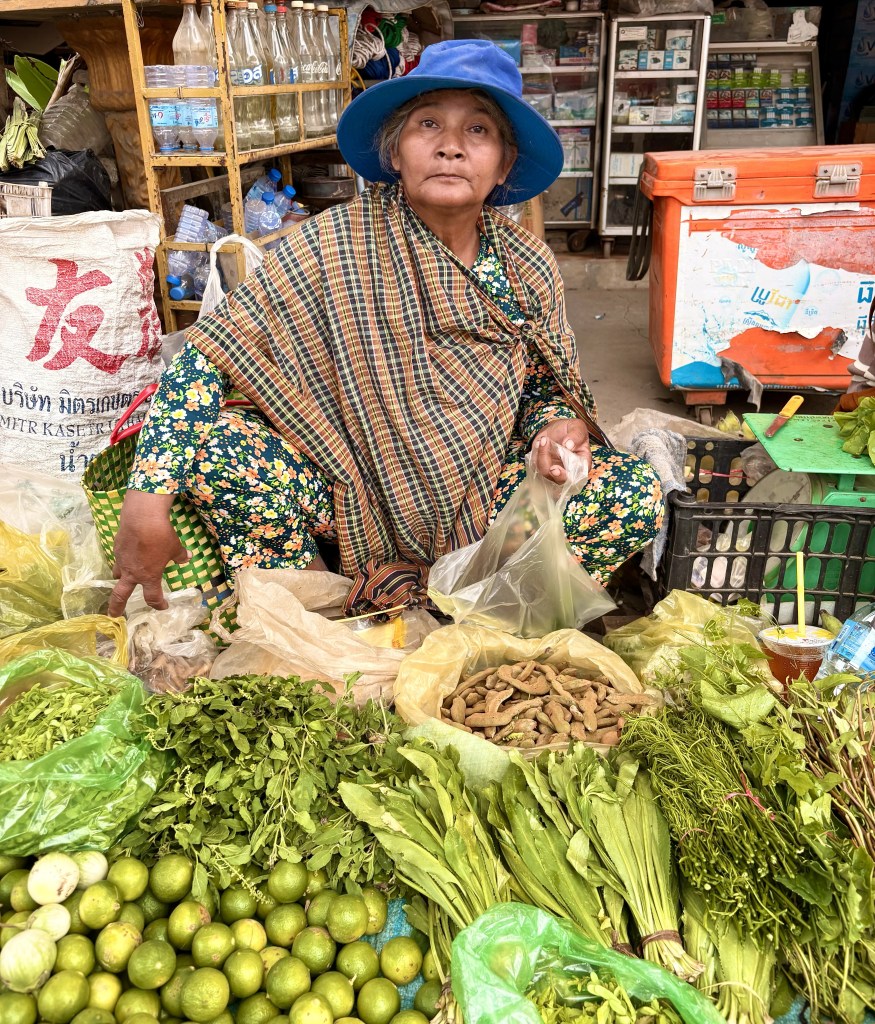
Food cooked for sale is available just about everywhere – in market stalls, from blankets spread on the grass in city parks and along waterfronts and from food carts pushed through the streets. The sale of grilled critters like rats and snakes is a fine example of making ends meet while improving farm production by clearing pests from the fields and paddies. Win-win.

Cottage industries dot the countryside, often clustered into speciality villages where neighbors all make and sell the same products along the same stretch of road. Jolting in tuk tucks over the rutted routes around Battambang, we visited sticky rice villages and rice wine villages, saw fishnet villages and car-part villages. In one village, we visited a mushroom-growing operation a Japanese NGO jump-started by paying people to replace low-earning pepper and cauliflower crops with higher-earning oyster mushrooms. The whole village of eight families is now dedicated to mushroom growing.

The days are long and margins thin for cottage industrialists. In the village of rice paper, we watched a couple make wrappers to sell for the spring and summer rolls that are a staple of Southeast Asian life.
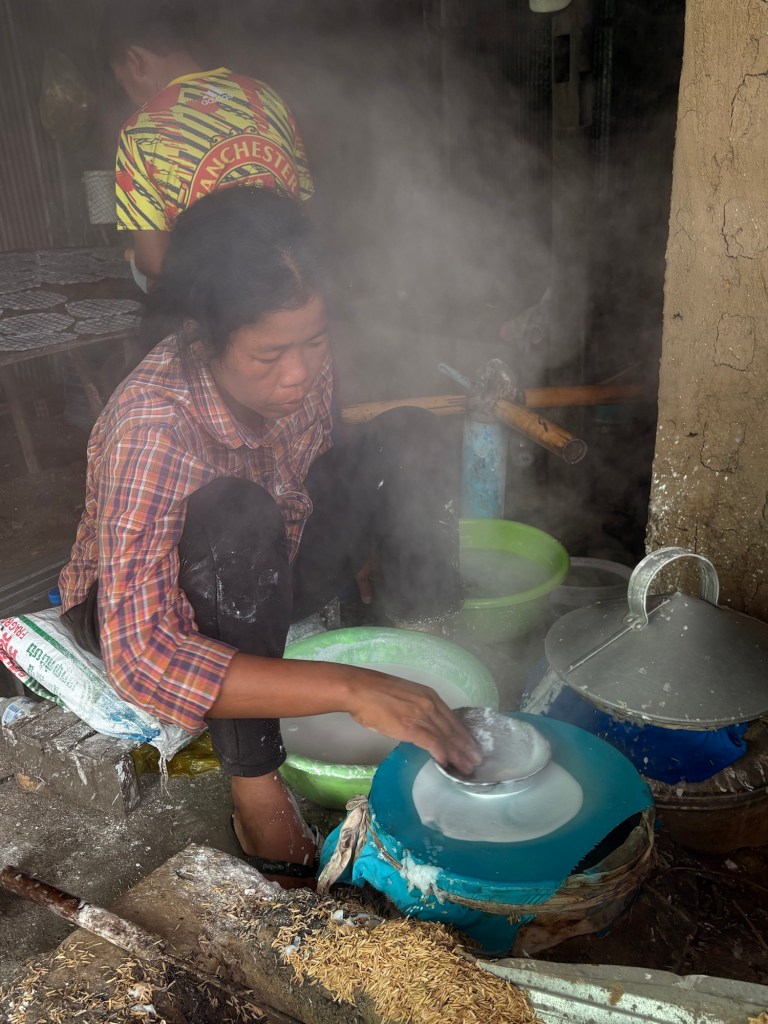
The process starts before dawn with cooking the rice to mix with water into batter. The wife is the cook, sitting on a law stool before two griddles, steaming each paper for a few seconds on a makeshift griddle before transferring it to wheel at her elbow.
The husband takes each paper from the wheel and gently unfurls it onto a bamboo rack about the size of bedroom door. When the rack is full, he carries it into the backyard to dry for 40 minutes in the sun before being sold.

The couple produces about 1,000 sheets of rice paper a day in this way, quitting only when the neighbors and restaurateurs who are their customers have bought all the rice papers they need until the next day. At $3 per bag of 100 handmade rice papers, they gross about $30 a day.
People in these home industries often learned the trade from their parents and pass it on to their children who haven’t gotten an education and moved. Someday, these operations may be quaint throwbacks tourists pay to watch. Today, they are the livelihood of countless rural families
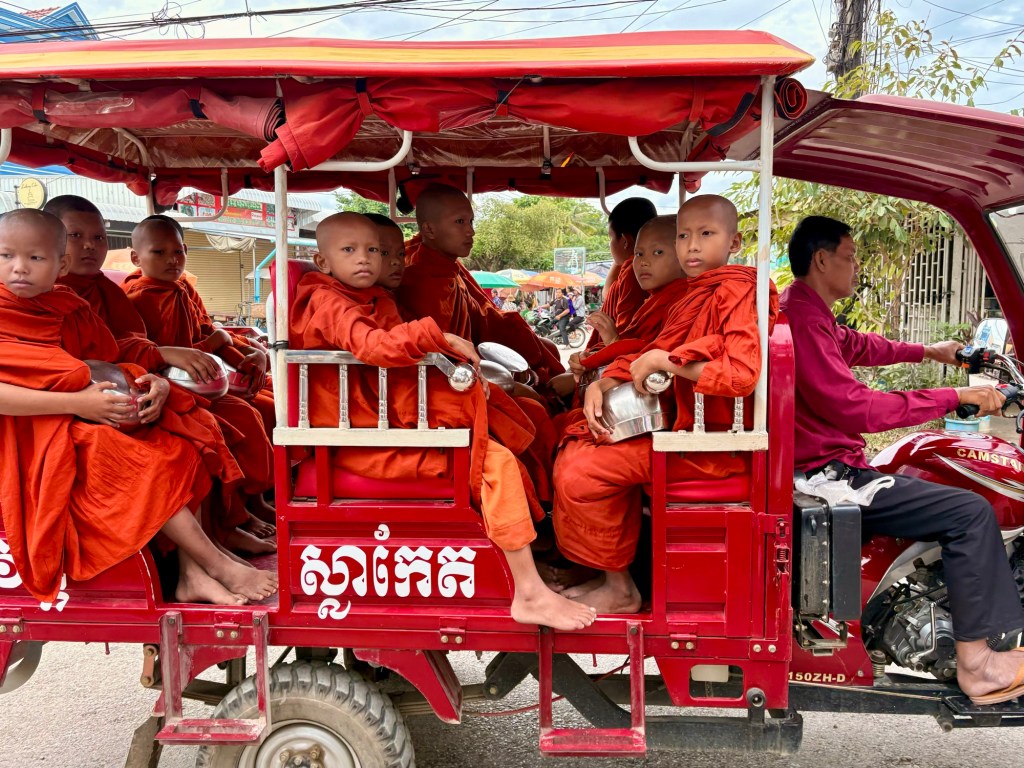
When a family can’t make enough to support its children (an average of two or three these days but many more in the past), sons may be sent to a Buddhist monastery to become monks. No child is turned away by a Buddhist monastery so parents can count on their sons being fed and educated, which is not otherwise free in Cambodia. One of the reasons our Siem Reap guide hadn’t saved enough money for a dowry was that he had become a Buddhist monk for five years to acquire the education his parents could not afford to buy for him.
There are darker ways impoverished families survive, practices implied by the flyers about child exploitation that NGOs plaster in public places. There are also industries we could not even identify. Whizzing between craft villages with our tuk tuk guide Kim, we passed a multistoried concrete building with shoebox-sized holes in its sides.
“Swallow house,” Kim shouted over his shoulder in answer to our question. Swiftlet nests in the houses are harvested and sold to China, Indonesia and elsewhere for food and medicine, going to show there’s no end to the means people find to make ends meet.

Who Knew?!?
Demining experts estimate it will take at least a century to clear the landmines and unexploded bombs that America’s “Secret War” left in the landscape of Cambodia. To hasten the process, African giant-pouched rats are being trained and deployed by APOPO, an NGO operating on the road to Angkor Wat in Siem Reap. Improted from Zanzibar because of their intelligence and relatively long life (eight years), two trained rats like the one in Doris’s arms need only 30 minutes to clear an area humans would need 4 days to demine. The rats work cheaper than humans, too: some banana and an avocado smoothie are all they ask.


 Partout with Louis & Doris
Fascinating! Good reporting job! Have read about those rats — they are also being trained to detect illegal export, eg ivory, pangolins.Vicki
LikeLiked by 1 person
The rats trained at APOPO are also specifically trained to detect TB. Sputum is spread in a tray covered by a grid a rat can smell through. If the rat scratches the grid, it means TB is present in the sputum. If it doesn’t, there’s no disease. They never fail and are capable of screening far more people faster than humans.
LikeLike
This is a fascinating report of your Cambodian travels. Thank you so much!
LikeLiked by 1 person
Always fascinating. Thanks.
LikeLiked by 1 person
Hello to you, Doris and Louis!
On the go again!
You just missed Brian’s family who was in Cambodia for a “Doctors Without Borders” kind of program. Brian doctored and Lindsey dentisted with the assistance of their two daughters. Such a life altering experience for all.
Hopefully we will see you in the desert again this year.
Much love,
Sally
Sent from my iPhone
LikeLike
Snakes and rats and swiflets, oh my!
I appreciated learning about life and culture in Cambodia. Thank you for the snapshot, and the snap shots!
I was wondering if couples circumvent marriage/dowery, or would that result in being outcast?
Continue to enjoy your travels!
Happy Holidays,
Ann
LikeLike
Thanks for following us, Ann. We did ask about this because it seemed impossible that marriage would be impossible. What we were told is that couples do live together for a while without being married if the dowry requirement can’t be met, but it’s not a desirable arrangement and not permanent. The man keeps saving until he can meet it. (He also has to pay for the wedding.)
LikeLike
Safe travels and Merry Christmas! Keep your back stretched!
LikeLiked by 1 person
So fascinating! Thanks as always for your thoughtful analyses! It sounds like you guys are having a great experience!
LikeLiked by 1 person
Beautifully composed and illustrated, as usual.
The dramatically different living begs the question — What is their happiness quotient? In advanced Western countries, we earn more and spend more without necessarily being happier.
LikeLike
There are doubtless unhappy people, and it’s hard for anyone to be happy if they’re hungry. Also, like everywhere, parents are heavy-hearted when they can’t afford to send their kids to school. But the country is still majority Buddhist, and people (like our unmarried guide) put a high value is put on not being discontents. They also believe in karma, which gives them hope that a better life lies ahead.
LikeLike