Day 168 – in the Bering Sea – find Insignia on CruiseMapper
It never occurred to us before leaving home that our world cruise would be a floating class on World War II in the Pacific. Frankly, we’re not what you would call war-history buffs. Learning about the Pacific Theater in WWII was not remotely on our radar screens.
But the best travel is an education, and what we learned about the second world war while traveling from the Philippines through Japan to Dutch Harbor, Alaska, was one humbling “Who knew?!” moment after another.
Insignia sailed more than 5,500 nautical hopscotching five sites of the nearly four-year war. Because that is way too much history to cover in a single report, this will be the first of a two-part Partout. For now: a personal mission in the Philippines and discovery in Okinawa.
The Philippines
Our first Pacific Theater lessons came in the Philippine Islands. Better students of war doubtless know Japan bombed the Philippines hours after attacking Pearl Harbor (along with Hong Kong, Wake Island, Guam and Singapore). Doris and Louis had missed or forgotten that history. Nor did we remember that Japanese troops landed in the island nation two days after the bombings, initiating a brutal three-year military occupation that left more than a million civilians dead out of a population of 17 million .
Military casualties numbered barely 10% of the total dead in the Philippines, but the American Cemetery and Memorial in Manila is nonetheless the largest US military cemetery outside the United States. The impeccably groomed burial ground sprawls like a giant park in an urban jungle. We ended up there because it happened to be on the itinerary of the “Old and New Manila” ship excursion we took in the city.

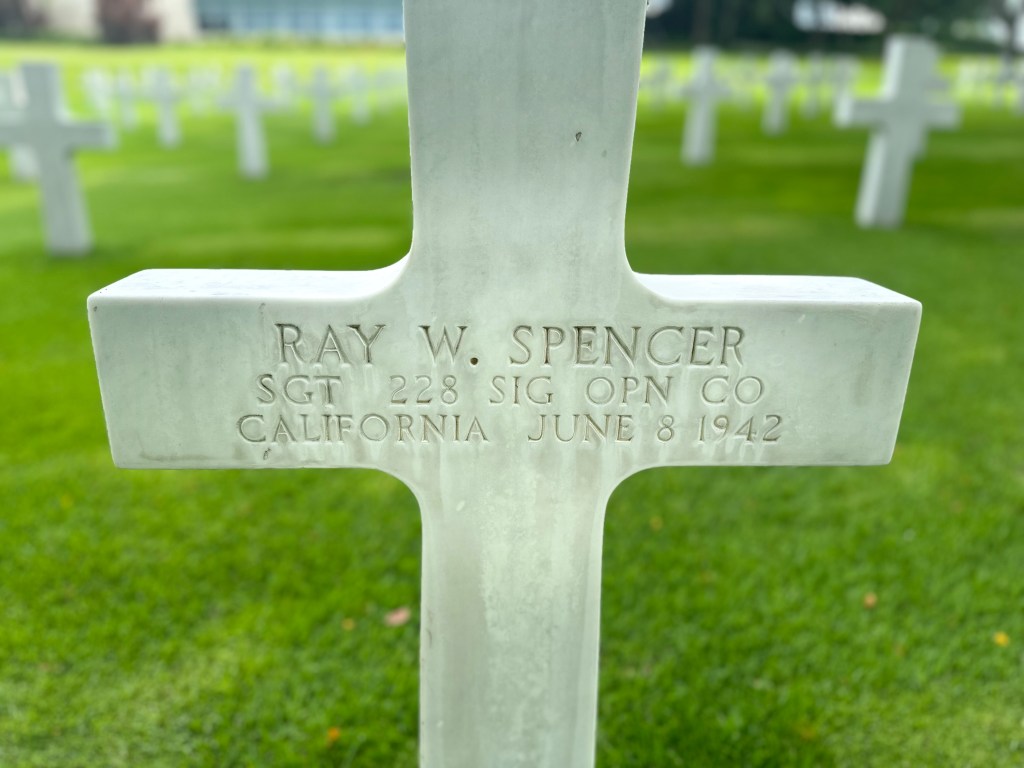
On our way to the memorial, the tour guide advised us that anyone who had lost a family member to WWII in the Philippines might be able to locate the grave through the cemetery’s next-of-kin office. Only then did Doris remember her grandfather’s stories of his eldest son surviving the Bataan death march but dying in the POW camp. Plunging frantically into genealogical records she could access on her telephone, she came up with her uncle’s full name before the bus had parked.
In the next-of-kin office, the cemetery officer took the slip of paper holding the name “Raymond W. Spencer” and typed it into the database.
“Do you know where he was from?” he asked after a brief pause. Doris did: California.
He nodded. “He is here.” A quiet young man, he swung his computer screen around so Doris could read more details than she had ever known about the uncle who died before she was born: his service number, unit and rank, and date of death.
Then the quiet young man led her into the park-like cemetery to Plot F, Row 8, Grave 6.
Standing at the simple grave of a man she had watched her grandfather mourn so many years animated the sad history of WWII in the Philippines in ways sheer numbers never could.

Okinawa
Okinawa was our next classroom. At least, we had dim memories of war in the Philippines from our school days. Okinawa was another matter. We had no clue Okinawans had been ruled by an indigenous dynasty with its own language, culture and ethnicity until it was invaded and colonized by Japan in 1609. We were equally ignorant that, when WWII came to Okinawa more than three centuries later, much of the population still did not speak Japanese or identify as Japanese.
Spending a day in the company of a native Okinawan guide and visiting the Peace Memorial Park and Museum on the island was like stepping into a river of revelation. We learned:
– The island was the only site of ground fighting on Japanese soil.
– The American landing on the island remains the largest amphibious assault in US military history, a crushing three-month battle Okinawans call the “typhoon of steel.”
– More than 200,000 people died during the battle, at least half of them civilians who were killed by relentless American bombardment and murderous Japanese policies toward them. The museum recreated scenes from their last days.

– Bones of war dead continue to be unearthed on the island and lives memorized on stone memorial markers that already contain 240,000 military and civilian names.
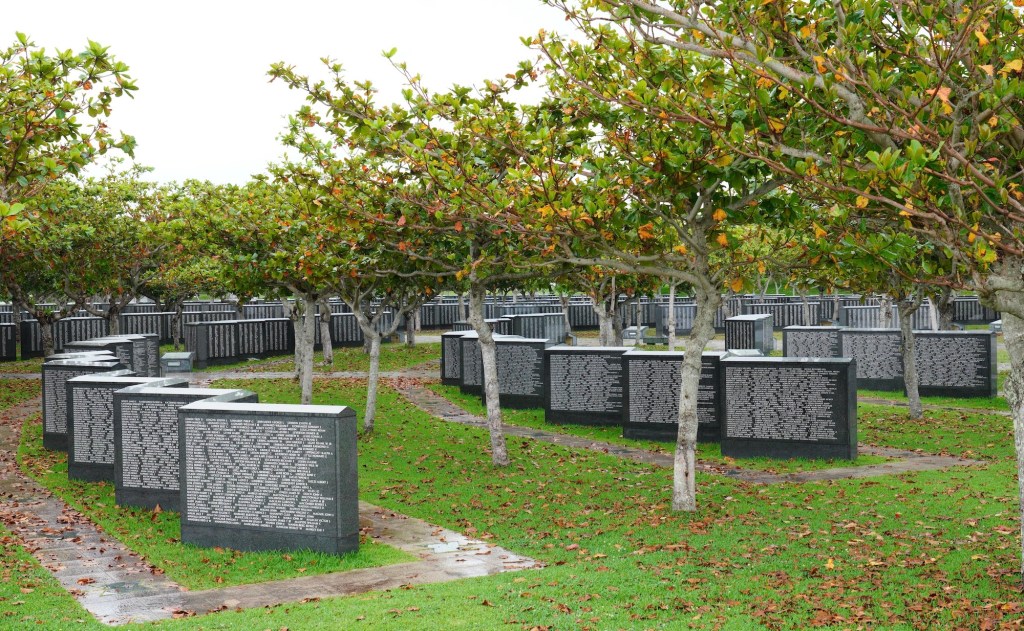
– Visiting the Peace Memorial on Okinawa is a common educational field trip for Japanese children from other islands, but local schools do not take their students there.
“The children have already heard the stories from their parents and grandparents,” our tour guide told us, struggling not to cry when she mentioned atrocities experienced by her own grandmother.
Eighty years sound like enough time for memories to fade. What we learned in the Philippines and Okinawa is they are barely a beginning for those whose wounds have never healed.

Another Question Answered
Curious Karen wrote, “You didn’t tell us your and Louis’s tally for number of countries visited. Below or above your fellow traveler Paul’s?”
Neither of us keeps a close count, but Louis said when we met that he had visited about 130 countries. That was 2010. Our travels have added 30 countries or so since then, including 14 new ones on the world cruise. That puts him at about three-quarters of the world.
Doris has been much more contained. She was at around 50 countries at the start of the cruise and added something like 30 with it. She does not expect to ever catch up with either of the guys.
Where’s Snowy?
Besides hiding out in a historic Japanese garden in Hiroshima on a sunny day? (Fair warning: after the impossible-to-miss Snowy in the Seychelles, this may prove nearly impossible to find. But she’s there!)


 Partout with Louis & Doris
This has been so fun to follow!!! I am nostalgic about the trip coming to an end!
LikeLike
and p.s. I was so touched and moved to see the grave of your relative- what a way to honor your grandfather and his son…with your visit.
LikeLike
Wow, Doris, I’ll bet it was overwhelming to stand on that sacred ground with your uncle.
LikeLike
How special Doris that you could identify your uncle at the cemetery.
We think the war memorials, al over the world, are always so impressive and watching the fields with uncountable crosses makes it hard to contain the reality of the event.
LikeLike