Day 141 – South China Sea – Find Insignia on CruiseMapper
The first time Louis left Ho Chi Minh City, was on April 30, 1975, the day the city – Saigon then – was taken over by the North Vietnamese. Louis was a 28-year-old cameraman for Canadian Television Network (CTV), a newsman assigned to the world’s biggest story.
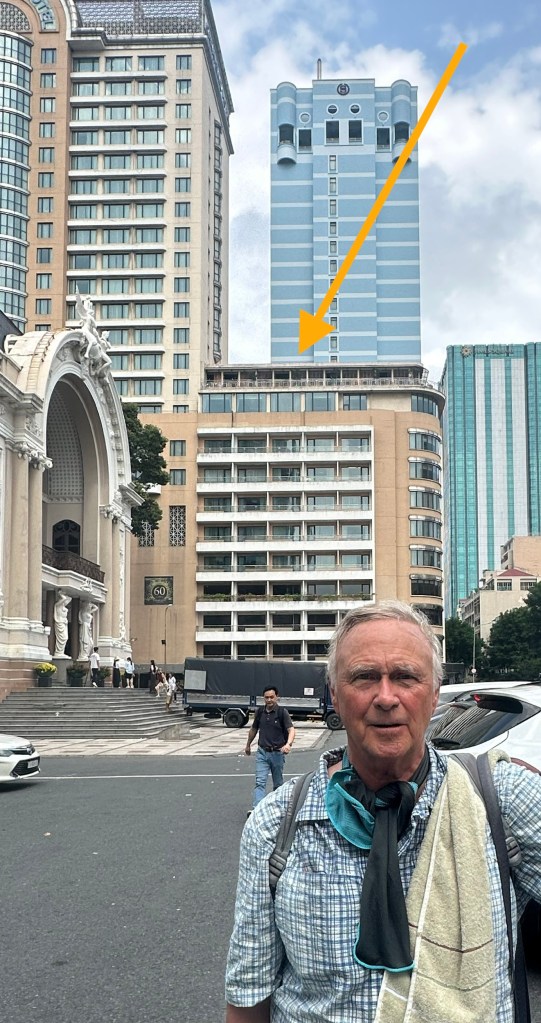
The imminent end to the interminable Vietnam War had been the talk in the rooftop bar at the Hotel Caravelle the night before.
Mortar fire was heavy and close. The South Vietnamese president had already resigned, and the city was encircled by North Vietnamese troops. It was just a matter of time before they took over the city, and now the time had come down to hours.
Into the Streets
When they awoke the next day, Louis and his reporter Henry Champ knew from the clamor outside their windows the time had come. They headed to the streets to cover the end of the Vietnam War. On the way out the door, they acquired a random Canadian tourist from the hotel lobby. The tourist (what was he thinking???) had recognized the red maple leaf on Louis’s camera and asked if he could come along as their soundman and escape from the country with them. They said he could.
Outside the hotel where Louis and Henry had lived for two months, chaos ruled. Everyone was going somewhere, anywhere, and fast. Men, women with children, whole families were running, biking, driving, scootering, fighting their way through the multitude, desperate to leave the city. Louis remembers filming, filming, filming but doesn’t remember whether Henry was interviewing, interviewing, interviewing at the same time. Knowing Henry, that must have been the case.
The pair worked the story until the only other Western journalists left were the ones who had decided to remain behind to cover the arrival of the North Vietnamese forces. After returning to the Caravelle for their luggage and remaining equipment, the two CTV newsmen and their volunteer soundman flagged down one of the US military buses ferrying evacuees to the airport and headed out.

Evacuation
But they had worked too long. The airport had fallen. The evacuation from the airport was over. Angry South Vietnamese soldiers left behind by the Americans fired on their bus, shattering the windows, scattering the passengers on the floor. Over the bus radio, Louis and Henry could hear the US Marine driver being ordered to take people anywhere but the US embassy.
The beach was mayhem. Boats were all but sinking under the desperate crowds that piled into them. The bus passengers unloaded briefly, then realized a sea evacuation would be impossible. Piling back into the bus, they demanded to be taken to the embassy. The driver complied.
The scene at the embassy is the one everyone of a certain age still remembers – the throngs of desperate people scrambling up the 14-foot wall in a frantic climb for safety. Most of climbers were Vietnamese, a few were Westerners. It didn’t matter that Louis and Henry were not Americans. White faces were all given a hand up and over. Brown faces were required to show an exit paper the US had provided its workers. Those with papers got a hand up. Those without got a shove back to the ground.
Louis doesn’t remember how he scaled a 14-foot wall, but he and Henry made it to the top and the helping hands. Once inside the compound, they resumed filming. After all, this was the world’s biggest story. Every 10 minutes, a helicopter lifted off, headed for an aircraft carrier off the coast to drop a load of evacuees before returning for more.
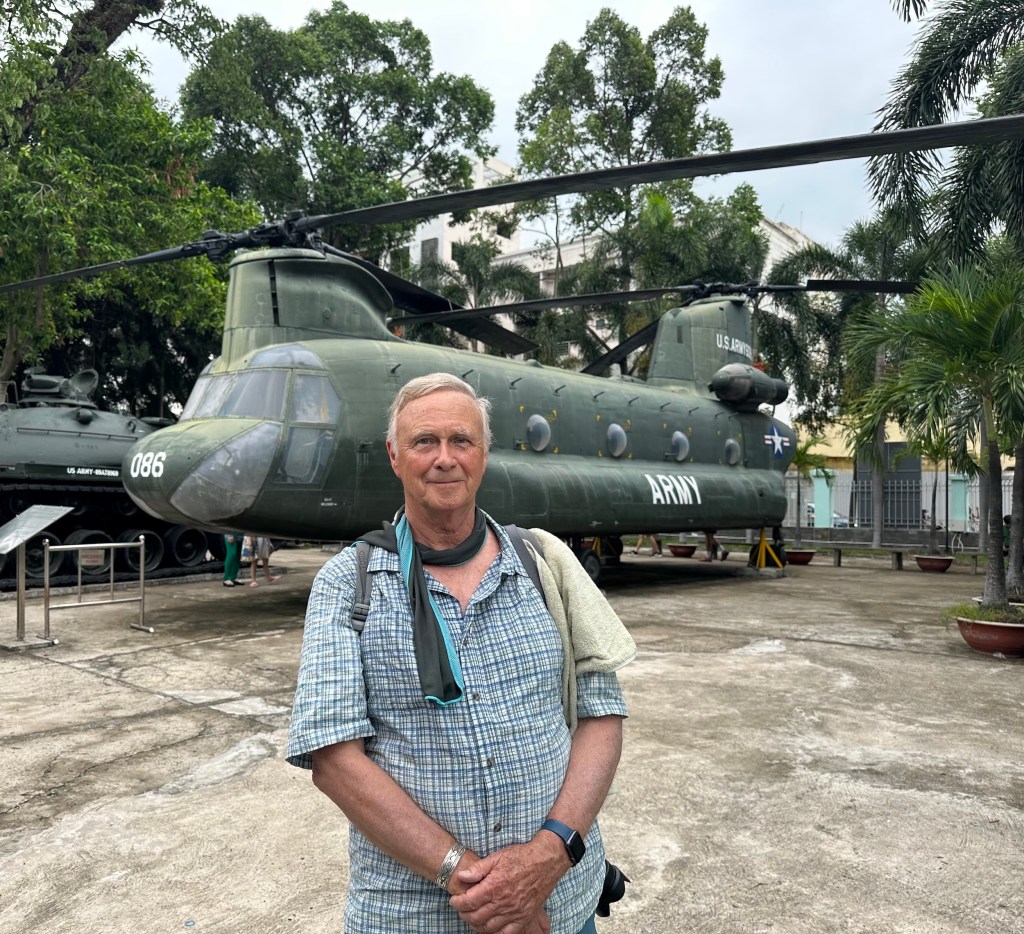
Louis and Henry boarded one of the last Chinooks (like the one pictured below) to leave before the ambassador himself took off. In less than 24 hours, 7,000 people left Vietnam the way they did, part of the largest helicopter evacuation in history.
Having waited so long to leave, Louis and Henry were now the only TV journalists on the aircraft carrier. Louis became the newsman who filmed the black clouds of helicopters flown from the abandoned US air base by escaping South Vietnamese carrying their families and pets and the tumult as one emptied helicopter after another was rolled into the South China Sea to make room for the next. Louis finally reached land at Clark Air Base in the Philippines, exhilarated by having been at the center of such a story, too young to fully appreciate the rarity of it.

The Return
Returning to Ho Chi Minh City via Insignia, Louis was on a mission to find as much what he could of that day and the two months of war coverage that preceded it.
The Hotel Caravelle is now the five-star Caravelle Hotel where drinks are still poured in a rooftop bar but to a vastly different crowd. The view to the Majestic, a war-era hotel that Louis and Henry had watched burn from their perch atop the Caravelle, is obscured by a next-door high-rise, but the famous Continental Hotel with its charming French patio furniture is still in full view.

To hunt down more sights, Partout hopped on the backs of two scooters with guides who zipped us around the city. The grandchildren of citizens who were young when Louis left the city the first time, the guides cheerfully sought out locations their ghost from the past distinctly or vaguely remembered.
Among the locations was the former US personnel residence at 22 Gia Long Street made famous for its rooftop evacuation of people who reached it by ladder. Louis’s guide found an image online to help set up a photo of the building (yellow, right). Today, 22 Gia Long Street is an apartment building. Before covid, Louis would have sipped coffee in its rooftop coffee house the guide said anyone could enter until the pandemic ended its long life.

The holy grail of Louis’s quest was the embassy building itself. Alas, the complex turned out to be long-gone, demolished in the late 1990s along with its iconic wall, both replaced by a gleaming new consulate.
Other memories awaited reviving. In the War Remnants Museum (the Museum of Chinese and American War Crimes until that proved to be less than highly marketable), the top floor is given over mostly to the photographs and lives of journalists who lost their lives covering the Vietnam wars. Among these was Michel Laurent, a Frenchman one year older than Louis when he was killed during action outside Saigon on April 28, 1975. The last photojournalist to die in the war, Laurent’s body lay in a ditch where Louis saw him on his own last ride from the front.

Back on the good ship Insignia, an eternity away from 1975 Saigon, guests asked how Louis’s quest affected him emotionally. He said it made him feel old. Landmark buildings may remain in the city but relatively few of the people who live there now were alive on April 30, 1975, or care much about it except as a date in history, long past and personally irrelevant. History has moved on.
Another Question Answered
Lizzy asked, “What trick in your 215 square feet is most clever that could be used in a ‘real room’ design?”
We tried to design an accessory dwelling unit for the back yard of our Sandpoint house last summer but gave up on the project when we could not get a 1-bedroom, 1-bath apartment much under 900 square feet. Now, we feel like designing 500 square feet would be a snap. The biggest trick would be cutting the bathroom down to size. We can stand in ours and touch all four walls without a stretch and you know what? It gets the job done, at least for one of us at a time; the rest is frosting. The next trick is the tried-and-true one of built-in storage.
And the final trick? Adopting “less is more” as a mantra and living smaller and neater. “Shipshape” has taken on a whole new meaning on the ship.
Where’s Snowy?
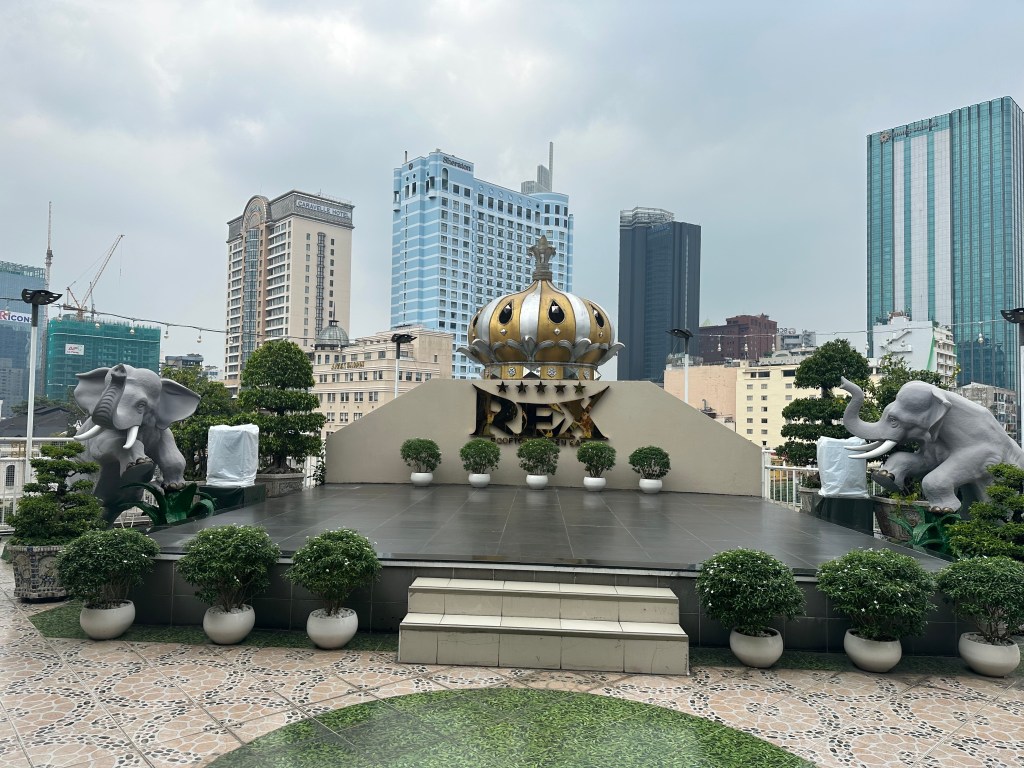
Besides hiding in the rooftop bar of the Rex Hotel, scene of the “five o’clock follies” where foreign correspondents were briefed daily by the American Information Service during the Vietnam War.

 Partout with Louis & Doris
Thanks for sharing this post, Doris! It’s great to read such a detailed (and objective) story about that fateful day.
LikeLike
Wednesday, June 7, 2023
Hi Louis,
Yours is an amazing story. Feeling old is not the half of it. You should feel blessed on this turn of the wheel. What you did was very dangerous. You could have wound up like your friend Michel Laurent. And it was one of the biggest stories anyone has ever had. Your films of the helicopters being pushed off the carrier are iconic, like raising the flag on Iwo Jima (only without the positive connotations).
Marvelous writing by Doris. Marvelous photographs by you. Enjoy the rest of your trip.
Steve Wolfe
San Diego, California
Mobile phone: 1 (619) 990-2827
LikeLike
WOW! This was such a moving and professionally journalistic account – thanks to Doris – of a seminal moment in history that remains vivid in the memories of those of us of a certain age. Revisiting those places that are forever etched in his memories must truly have been a standout in a trip full of highlights. One question: do you know what became of the Canadian tourist who hitched that harrowing ride to the Embassy?
LikeLike
Moving story of Louis’s experiences in the war–sent chills up my spine!
LikeLike
Wow, this is really a touching report. Amazing recount of Louie’s hair-raising episodes and then the poignant revisit to the memorable locations. The Vietnam War seems ages ago but it was such a formative event in our lives — in some lives so much more than others. Thank you for this recounting — beautifully described and great photos.
LikeLike
Your story revives the remembrance of this horrible period and makes us quiet and humble.
That Louis was in the middle of it makes it more impressive.
To be an eye witness and a long time participant in that war must be a burden for life.
We are so happy to know Louis as a mild and optimistic friend.
LikeLike
Sitting in Horizons and cried while reading this. Wow.
Craig Yoder (614) 361-6716
>
LikeLike
Wow. I had no idea of your experiences in Vietnam. That is remarkable!
LikeLike
What memories for Louis. A scary time for sure. Good thing he was young and innocent of what could and almost did happen.
Now for a question. You’re nearing the end of your trip. Did you take enough clothing, toiletries etc. Or did you wish you had taken more? Less?or was this just the right amount?
LikeLike
Fred says the Ford Musrum in Michigan has the ladder they used at the embassy to get on the helicopter from the roof of the embassy. When they tore down the embassy they gave this ladder to the presidential museum…
Loved this description of Louis great work!!
LikeLike
I remember well the April and May 1975 days when Louis was missing in action for his family and particularly for his mother and father. Louis has had several harrowing experiences in his life. All I can say is thank God he is still with us.
LikeLike
Amazing story of Louis’ documentation of an historical time. I loved learning about his impressions from now and then. Also teary-eyed to be reminded of the strife, as doesn’t seem to have gotten us to far ahead almost 50 years later. XO, Ann
LikeLike
Thank you for writing this account. It was really interesting and moving. Glad Louis got back to experience it in 2023.
LikeLike
Wow. I must say you two have outdone yourselves on this amazing post. What stories! Surely, there must be a streaming series proposal in the works? A compelling piece of work here. Thank you.
LikeLike
Wow!! Wonderful story. Thanks for sharing this memorable event.
LikeLike
Fabulous, the text, the photos, you both!
LikeLike