Day 134 – Ho Chi Minh City, Vietnam – Find Insignia on CruiseMapper
Three times a day on Insignia, an expansive and beautifully presented array of food is laid out in the ship’s buffet restaurant. Four decks below in the main dining room, another array is plated and served to seated diners. Elsewhere, at dinnertime, teatime and various times in between, smaller selections of food are served up in other venues.
Where does all this food come from, and how does it get to the table? This is the story of how smiling faces like these are able to feed the multitude.

Consumption
First, let’s establish how much food we are talking about.
Per official reports, guests on an average world cruise consume 36,600 eggs, 6,428 pounds of beef, 2,720 pounds of shrimp, 28 tons of fruits and vegetables and 800 pounds of chocolate. Roughly 3,000 items in all. Typically, these are washed down with 822 bottles of wine, 242 bottles of champagne, 347 bottles of spirts and 2,992 bottles of beer, plus untold filtered water, sodas, etc.
All this makes for a whole lotta boxes like the ones below photographed as they waited on the dock in Cape Town to be taken aboard.
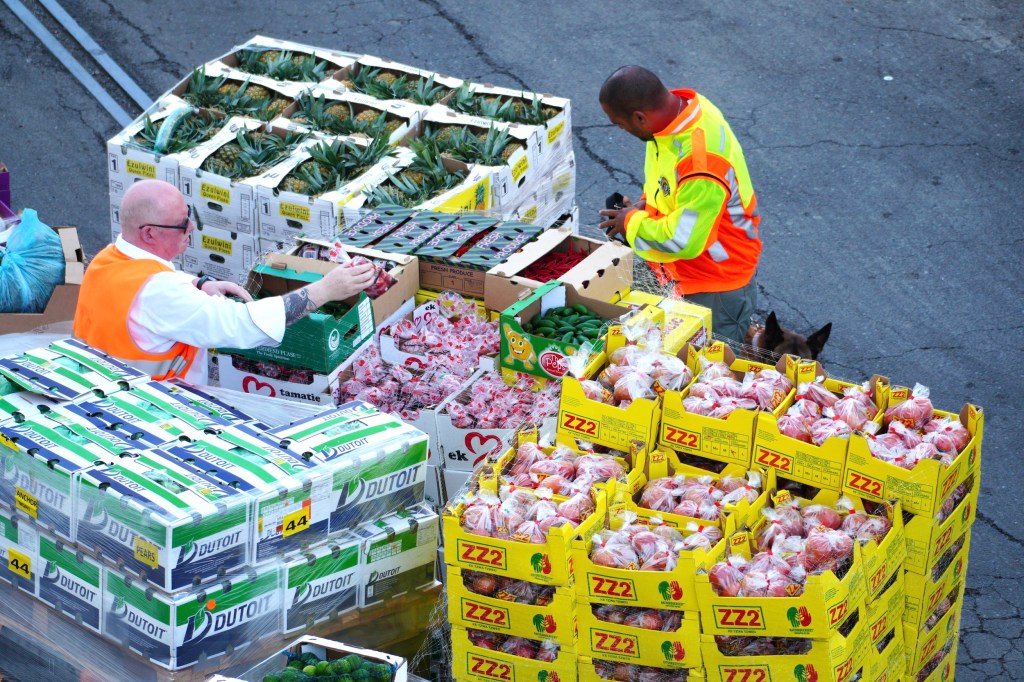
A guest chef who had been behind the scenes told us the ship’s food service works like a military operation. How much French flour is needed to keep passengers in fresh baguettes three times a day, how long will the flour remain optimum in storage, and which ports are capable of handling the delivery?
Multiplied by 3,000 items….
Stocking
The ship has space to store up to two months of food. The guest chef told us the onboard food stores are so packed with food after a provisioning stop that it is hard to walk through the aisles. (OF COURSE, we asked for a tour of these backstage places. We are journalists! The absence of first-person reporting on them indicates the answer.) By the time the next provisioning stop is reached, the shelves are all but bare.
As passengers, we monitor supply levels with our palates.
The raspberries always seem to be exhausted first. Then the blueberries. Chives, for some mysterious reason, have a very short cruise life. Lettuces vary wildly by setting; we’ve been through butter-lettuce seas, romaine seas, arugula seas.

On a few cruises, garlic has run low. One of the most enduring mysteries (and aggravations for many passengers) is that the kitchen can come up with a cornucopia of fresh-vegetable salads – and endless tomatoes! – but offer only the same boring medley of steamed root vegetables as a side dish at every meal. We know, first-world problem but still a mystery.
Delivery
Some foods are sourced locally and reflect the location. Mango, papaya and dragon fruit made their debut in South America, lychee nuts in Asia. The fresh produce and dairy products last only 10-14 days so the ship buys them as we go, another military-like operatiion. It’s one thing to buy a kilo of fresh strawberries for the family, quite another thing to secure a quarter-ton of them.
Fish is often sourced from the docks or open markets in whatever port the day finds us. It, too, varies varies by location. We are already looking forward to the Alaska salmon.
More typical, dry goods like pastas and canned ingredients, bonded items like alcohol and tobacco and frozen goods like meats, ice cream and the cursed tasteless vegetables are sent to us via ocean container from the United States or Europe. (All our beef, btw, comes from the US except when Argentinian beef is at hand.) It takes as many as six 40-foot containers to convey all these ingredients to Insignia. Each container holds up to 250 two-ton pallets – about 6 million pounds in all.

QA & Loading
Your Partout pair had the unexpected (and sort of pathetic) opportunity to observe quality control and loading of these products when we were confined to quarters with covid on our first day in Cape Town, South Africa. Our stateroom is midship on the port side, which means we typically face the dock from 50-yard-line seats. In Cape Town, our veranda had a birds-eye view of the biggest provisioning operation to that point.
Truckloads of goods began arriving dockside as soon as we were tied up.

A forklift was on hand to move pallets.
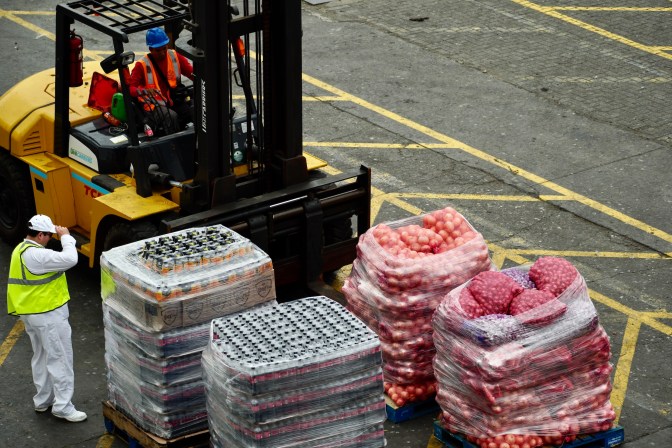
Each box of perishables was unloaded, sorted and opened for inspection. The inspections were astonishing. Personnel sniffed. (And, no, we have no idea what “The Peps” are behind the sniffing assistant chef in this photo. Bell peppers?)

They sliced.

They examined. (The examiner is the executive chef.)
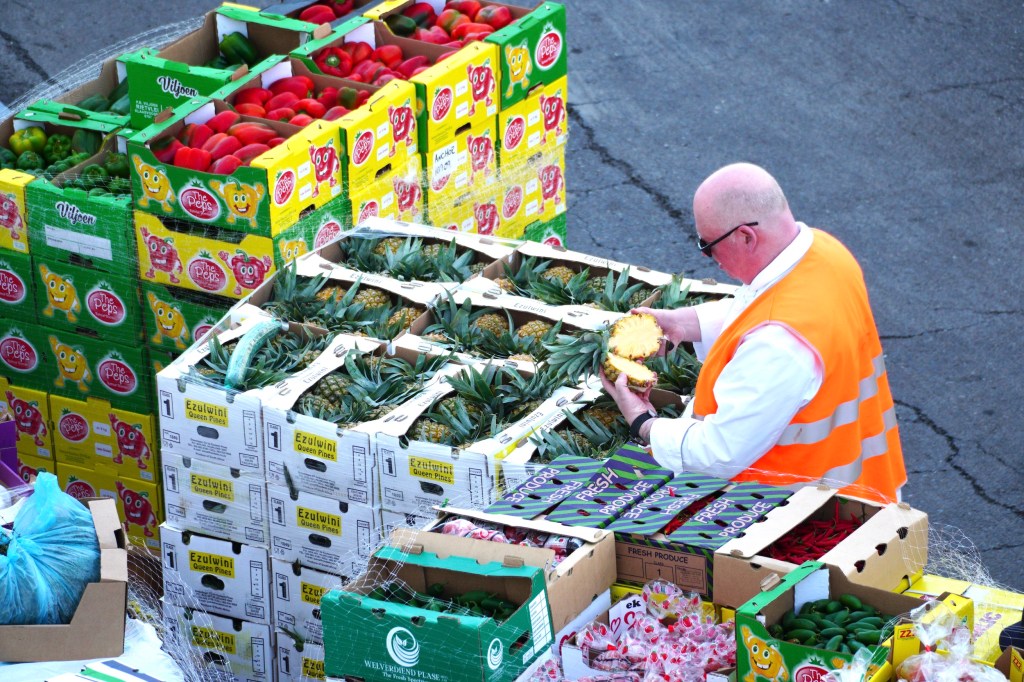
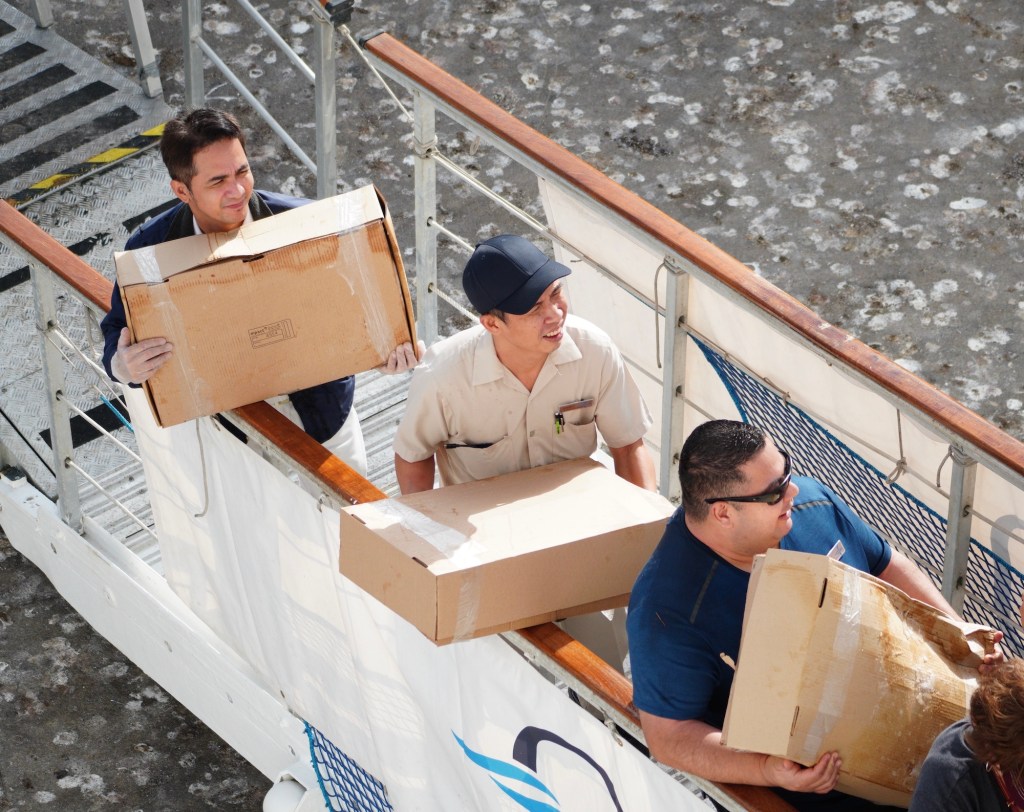
Some products were rejected, most were accepted. The ones not conveyed onto the ship by the port’s conveyor belt game up the gangway by hand.
Leftovers
We are told that leftovers from the passenger buffet and dining room kitchens go to the staff and crew dining rooms. Edible remains – about half the waste – are ground and fed to the fishies, a process we have never seen but would love to observe. The rest of the remains are bundled up and disposed of in the next port.
At some level, it seems obscene that so much time, money and energy goes into fattening up a shipload of affluent, superannuated travelers when there are so many hungry people on earth. Rather than guilting myself over being among the former, Doris wishes the technology and organization that goes into feeding so few so well could be implemented by governments and organizations to feed the underfed. If 6 million pounds of food can be conveyed from the US to a moving target every three months, surely we can do better for the estimated 30% of the world living with food insecurity.
Another Question Answered
Amey asked, “How do your feet manage with all the miles? Your footage is quite remarkable.”
Days like the ones in Singapore, when we hoofed 7-8 miles a day, are unusual. Typically, we are in the 10,000-step-a-day zone that we try to maintain at home and whenever we travel. We are lifelong walkers, and old habits help. What has been more challenging than the walking itself on the world cruise are the weather and the walking conditions.
With the exception of a couple weeks in southern and southeastern Africa, temperatures and humidity have ranged from miserable to hellacious for nearly three months. Passengers have passed out cold on shore excursions, sometimes hurting themselves as they have fallen. They have passed out cold on the ship. We pace ourselves to avoid that, but we also have been limiting how much we see and do on any given day, a bummer but better than the alternatives.
Also never far from mind as we wander the world is where we set our feet. Walking on ancient, unmaintained or merely undeveloped paths can be hazardous and doing it while gaping at the sights (or at a cell phone) is a roadmap to the emergency room. We know fellow passengers who have broken wrists, arms, kneecaps, ankles and various hand digits or scraped and abraded themselves to the extent they needed to be stitched or even hospitalized.
So far, so good for us, but we never take a day for granted.
Where’s Snowy?
Besides watching the action at a cave rave the ship hosted for its world cruisers?


 Partout with Louis & Doris
Found any pot or white powder in your cucumber or pineapple yet?
LikeLike
Loved this report! Behind the scenes with Doris and Louie! I just finished a week long sea going venture with 35 combined passenger and crew. The bananas and the easiest to observe going from slightly under to slightly over ripe, and then gone! Cole slaws and the like always available! 🙂
LikeLike
Yes. I’m still here, reading as you cruise, walk, and eat Jess has your front yard looking like a slick magazine feature. I’m off to meet up with Tom at the end of the week. We shall provision on a much lower level.
LikeLike
Louis and Doris,
I read your write-up (I read every one) and cannot help but feel you’re going to say good-bye to some great folks. Hope you have plans for them. But generally speaking, the list of stuff that goes aboard ship is amazing. Glad you didn’t get Covid too badly!
LikeLike
Salut Louis … ma nouvel
LikeLike
Still trying to wrap my hands around Vietnam history and the place it has become. It’s a tension between what was, is and becoming that I’m wrestling with as the foodie pictures glow the past five years from our next generations with no understanding of the war, the losses and the agony. I’m trying to bridge my thoughts; the images of the 60s with the present. Hard to honor both and.
LikeLike