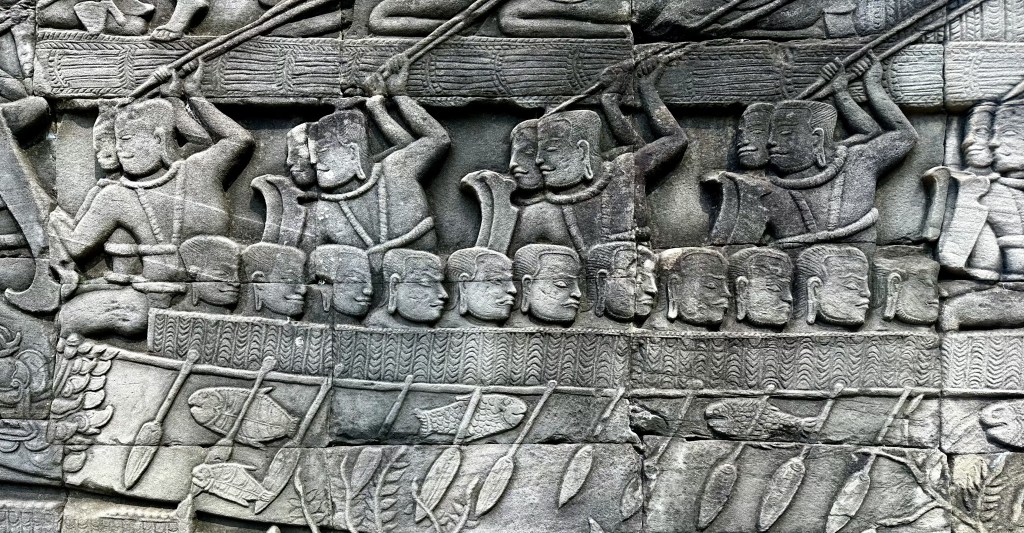
Waterways are story masters, bearing tales so old you find them painted on the walls of Egyptian tombs and etched into the galleries of Cambodian temples. Choose the right waterway and time stops.
Stopping time pretty much explains how we ended up on the slow boat to Battambang, Cambodia’s second city. Having seen the past of the Khmer people at the wats of Angkor, we were curious to see the present on Tonle Sap, a waterway where people have lived since prehistoric times.
In a touch of irony, “Express Boat” chugs away from Siem Reap at 8 o’clock every morning and arrives on the outskirts of Battambang . . . whenever. Maybe four hours, if the water is high and nothing goes wrong, maybe more. Ours took seven hours, and the hotel receptionist told us we were lucky. Some take eight or nine. Calling it “the slow boat” is also a bit misleading. Ours was the only boat. The “fast boat” is a wheeled taxi.
When we boarded, we thought the colorful wooden craft might carry up to 20 passengers to go with its 10 life preservers, but we kept plucking new riders off other boats and floating houses along the way. Some joined us inside, others jumped on the roof to join our luggage.

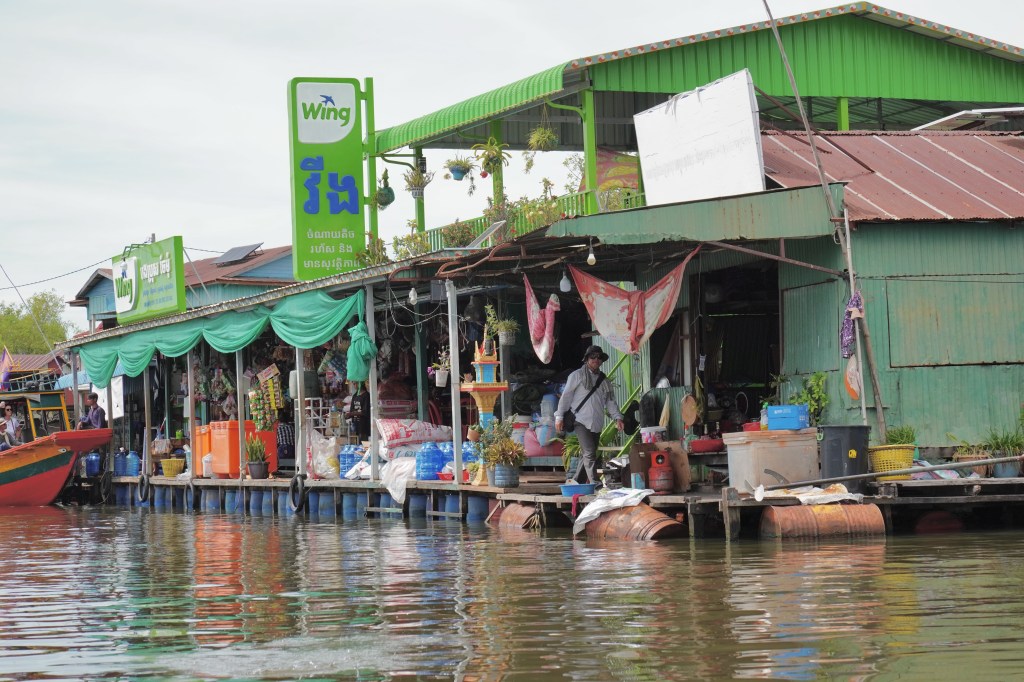
Tonle Sap is the largest permanent freshwater lake in Southeast Asia and water’s version of a metropolis. An estimated 80,000 people dwell in more than 170 floating villages on the lake, often complete with floating markets, schools, temples and basic services. To survive the ups and downs of the water level, some of the homes float on barrels, others stand on stilts.
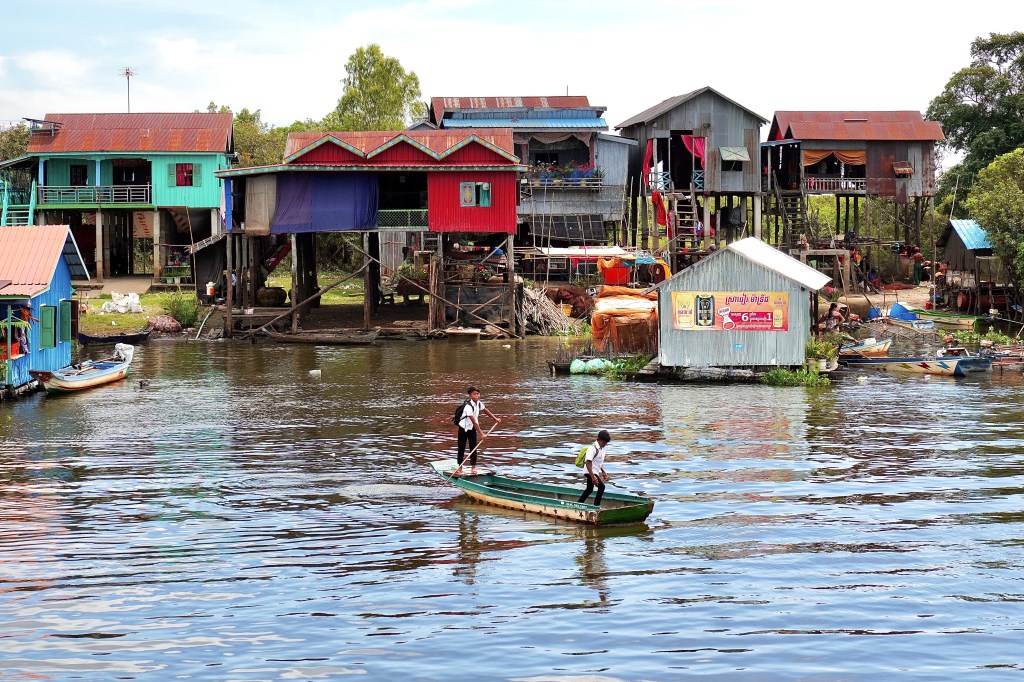
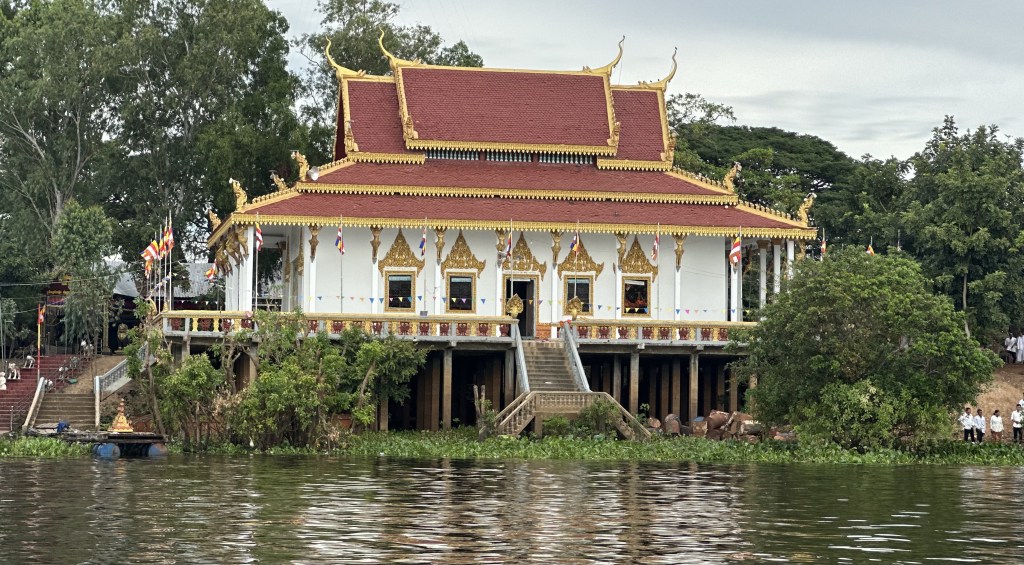
Even the biggest structures, temples and schools, are stilted
Boats on the liquid highway take innumerable shapes, most of them humble. The best-off people drive sleek long-tail boats with surface propellers. The less fortunate and youngsters under maybe 10 paddle. A minority appear to use their boats as homes as well as transport.
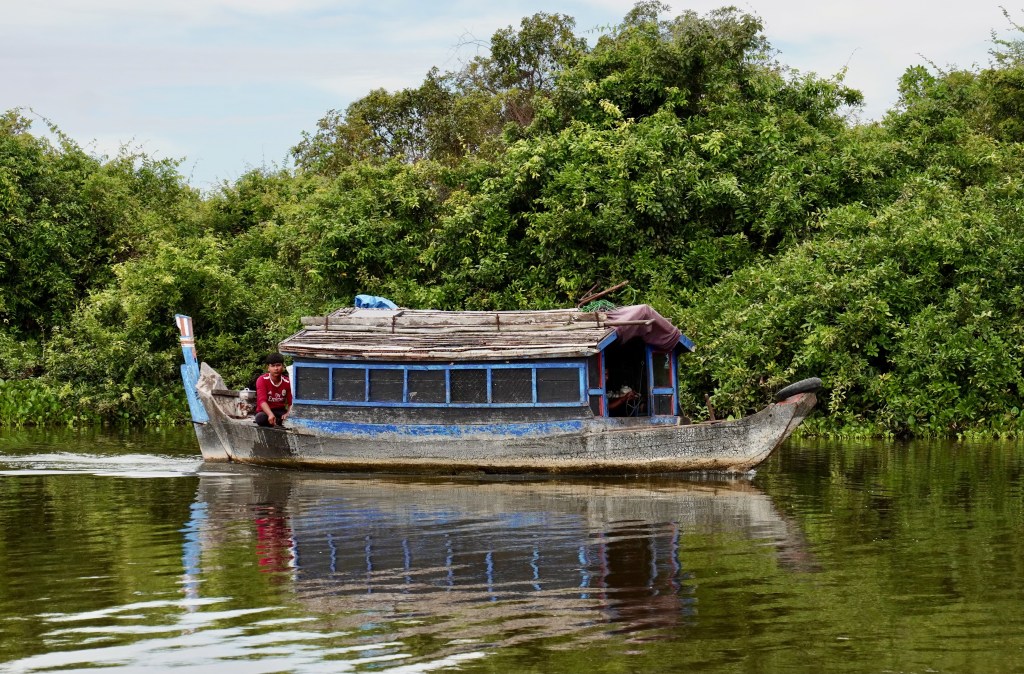
Cargo moves on the water.

And villagers make their livelihoods from it. A staggering three-quarters of Cambodia’s fish production comes from the fishermen of Tonle Sap who usually use large stationary trawl nets called dai to capture migrating fish.
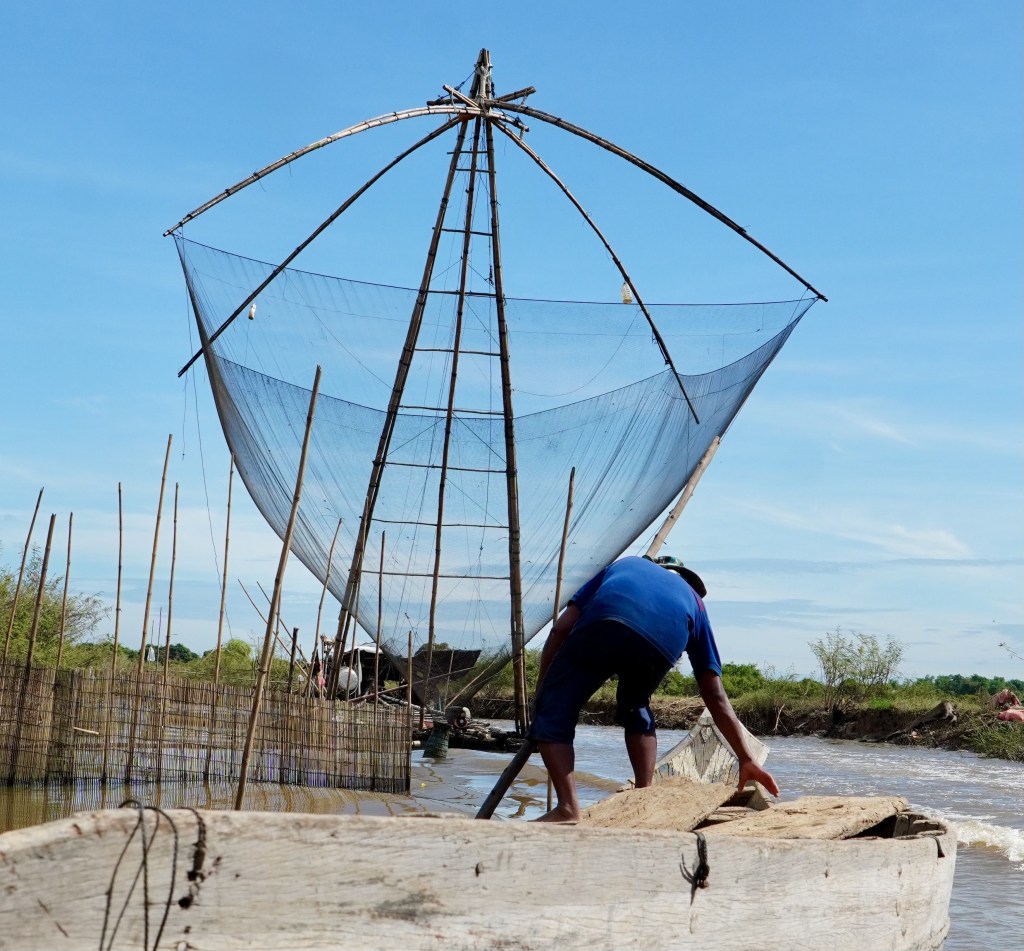
Express Boat picked up packages along the way like an aquatic pony express. As a new village came into sight, the pilot would blast the boat’s horn, and locals would slide up to jump aboard or hand off goods.
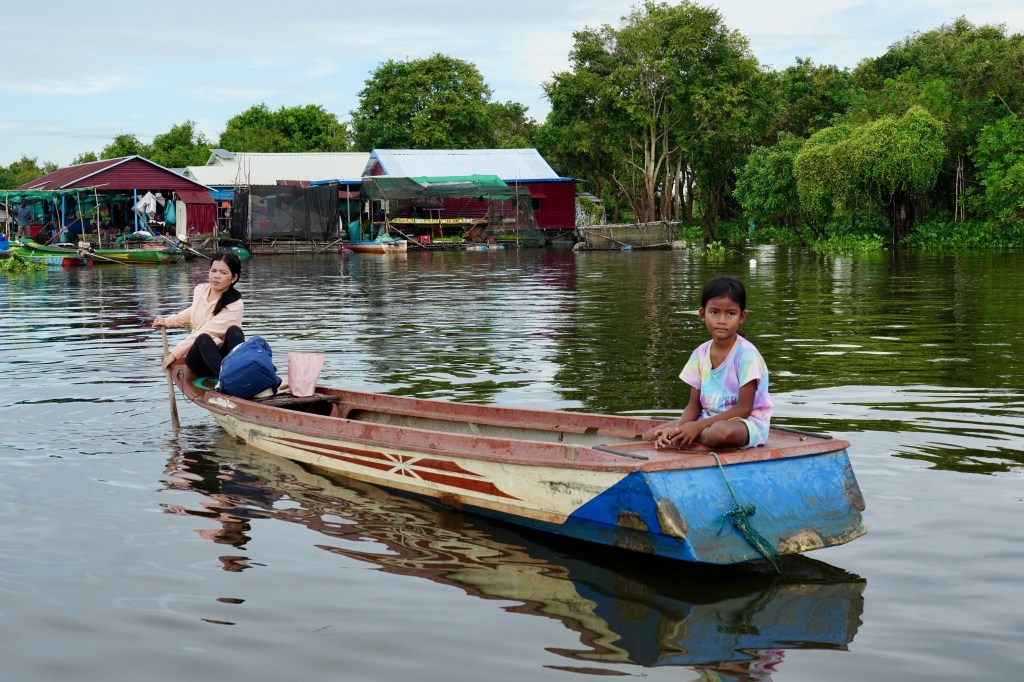
Bundles would be hefted aboard.

Money would change hands.

Some of the cargo went onto the roof with our luggage and latecomer passengers, some onto the bow to block Louis’s view.
Just as we thought the journey might never end, we stopped for a 15-minute lunch and a toilet break. For $2, Louis and I shared a paper plate of rice and chicken-something in a convenience store complete with strolling chickens.
We could easily imagine the Tonle Sap’s stories being written on the Nile or the Amazon or the Yangtze or the Mississippi in bygone days except for the foliage. Open water would suddenly disappear under lotus forests growing as far as we could see. When the propeller choked on the pads and pilot killed the engine to clear it, we joined slow boats of the past in the timeless silence of the water.

Who Knew?!?
During Cambodia’s wet season of June to October, Tonle Sap increases to 5 or 10 times its dry-season size as the Tonle Sap River surges into it. That’s when the slow boat is not so slow. During the dry months, the river reverses course and sucks the channels we rode dry. In the Cambodian version of making hay while the sunshine, lake dwellers turn the lakebed into gardens where they raise fast crops like chili peppers and watermelon and jolt over the cracked soil by motorbike until the rains raise the water again and return them to their boats.

 Partout with Louis & Doris
very nice photos , and a very pleasant trip
Dominique and Muriel , from France
LikeLiked by 1 person
This post made me laugh out loud! Grey photos and I learned a lot!!Sent from my iPad
LikeLiked by 1 person
I’m so enjoying your adventures! We just got home from a 2 week vacati
LikeLike
Oh my gosh, Doris and Louis, That was one of the most entertaining and humorous posts you have written so far! What fun to read! Thanks for making me laugh. Tamara
LikeLike
What incredible reportage and photos! Keep it coming!
LikeLike
Love it! Asante sana for sharing
LikeLiked by 1 person
Wonderfull!
LikeLiked by 1 person